






The Hidden Cost of the Hunt
The problem isn’t just the minute or two spent walking to another room for a book or navigating a labyrinth of digital folders. The real damage is cognitive. Every time you shift your focus from your primary task to a search, you incur a 'context switching'
cost. Research shows it can take over 20 minutes to fully regain deep focus after an interruption. Those little trips and clicks add up, fragmenting your attention and draining the mental energy required for high-quality work. Constantly stopping to find information forces your brain to unload the context of your main project, load the context of the search, and then attempt to reload the original context upon your return. This process is inefficient, increases the likelihood of errors, and is a primary reason why a day can feel busy but ultimately unproductive.
Engineering Serendipity and Discovery
Keeping reference materials within arm's reach is about more than just minimizing friction; it's about maximizing discovery. When books, articles, and notes are physically or digitally adjacent to your work, you create an environment ripe for serendipity—the act of finding valuable things by chance. You might reach for a dictionary and your eye catches a title on the same shelf, sparking a connection you wouldn't have otherwise made. This is the power of the 'prepared mind' that scientists and creators have long valued. Accidental discoveries, from penicillin to Viagra, often happen when an observant person notices an unexpected detail. Your workspace can be an engine for these happy accidents, but only if the raw materials for discovery are present. By surrounding your work with its supporting material, you are, in effect, laying a series of fortunate traps for your own mind.
A Lesson from the Analog World
This principle is hardly new. Consider the concept of 'mise en place'—a French culinary term meaning 'everything in its place'. Professional chefs don't start cooking and then run to the pantry for every ingredient. They meticulously prep and arrange everything they will need—chopped vegetables, spices, sauces, and tools—within immediate reach. This system allows them to execute complex dishes under immense pressure without breaking their flow. The same logic applies to knowledge work. Famous authors have also intuitively understood this. While some, like Virginia Woolf, worked with a simple lapboard, their essential tools were always close. The goal is to create a 'cockpit' for your work, where everything necessary for the journey is readily accessible, eliminating the need to put your creative process on autopilot while you search for supplies.
Translating the Principle for Digital Work
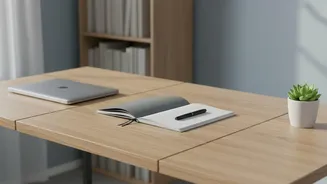
In an era where the 'bookshelf' is often a hard drive, the principle remains the same, but its application must adapt. A desktop cluttered with random files and a browser with 50 open tabs is the digital equivalent of a messy, disorganized library. The solution is digital mise en place. This means creating a clear and consistent folder structure for your projects. It means using reference management software like Zotero or Papaly to organize sources, rather than letting them pile up in a downloads folder. It means using split-screen views to keep your source material visible while you write, mimicking the act of having a physical book open next to your notebook. The key is to make finding information a seamless part of your workflow, not a disruptive detour. By intentionally designing your digital space, you reduce the context-switching penalty and keep your train of thought firmly on track.