




The Tyranny of Distance
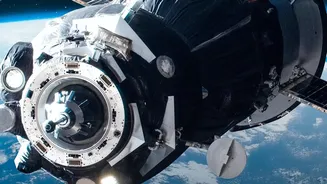
For astronauts on the International Space Station (ISS), Earth is a relatively short 400 kilometres away. This proximity allows for regular cargo missions to deliver food, water, oxygen, and spare parts. But a trip to Mars is a multi-year endeavour. A
constant lifeline to Earth is impossible; the sheer weight and cost of launching years' worth of supplies are prohibitive. This logistical constraint has been one of the greatest barriers to planning long-duration missions. The ISS itself is an open system, dependent on resupply. For humanity to become a multi-planetary species, spacecraft can no longer be cosmic campers; they must become self-sufficient arks.
The Closed-Loop Concept
Enter the closed-loop life support system, a sophisticated set of technologies designed to recycle nearly everything an astronaut needs to survive. Known formally as Environmental Control and Life Support Systems (ECLSS), these are not new concepts. Versions have been used since the early days of spaceflight, but the goal has always been to move from partially regenerative systems to a fully closed loop that mimics Earth’s own natural cycles. The ultimate aim is to create a miniature, self-sustaining biosphere inside a spacecraft or habitat, recycling air, water, and eventually, waste, to support human life indefinitely.
Recycling Air and Water
On the ISS, great strides have already been made. The station's ECLSS can reclaim about 98% of the water from sources like crew members' urine, sweat, and breath. This water is purified to standards often exceeding those of municipal water systems on Earth. For air, systems scrub carbon dioxide (CO2) from the cabin, often using chemical beds or molecular sieves. Advanced systems, like the Sabatier reactor or ESA's Advanced Closed Loop System, can then combine captured CO2 with hydrogen (a byproduct of splitting water to make oxygen) to create more water and methane, further closing the loop. This reduces the amount of water that must be launched from Earth, a huge saving in mass and cost.
The Next Frontier: Food and Waste
While air and water recycling are becoming highly efficient, the toughest challenges remain: food production and solid waste processing. Currently, all food for the ISS is sent from Earth. A true closed-loop system for a Mars mission would need to include bioregenerative components—essentially, a high-tech garden. These systems would use plants and algae to produce food, which in turn would absorb CO2 and generate oxygen through photosynthesis, creating a symbiotic relationship with the crew. Similarly, technology must be perfected to process solid human waste and leftover food, converting it into nutrients for plants or other usable materials, thus eliminating waste entirely. NASA and other agencies are actively investing in these 'biomanufacturing' capabilities.
Enabling Mars and Beyond
A reliable, fully closed-loop system is a game-changer because it fundamentally alters mission architecture. By drastically reducing the need for supplies, it decreases the initial launch mass, making missions more feasible and affordable. It provides a critical safety buffer; if a problem arises, the crew has a sustainable environment to rely on while they troubleshoot. This technology is not just an improvement; it is an absolute necessity for establishing permanent bases on the Moon and sending the first explorers to Mars. While powerful rockets capture the imagination, it is the quiet, constant work of these regenerative systems that will truly unlock our future in deep space.