



The Digital Sky Watchers
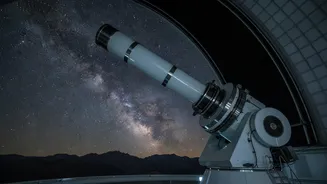
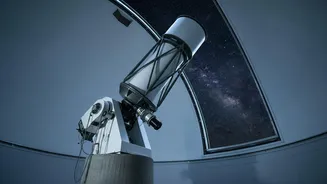
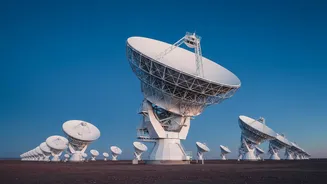
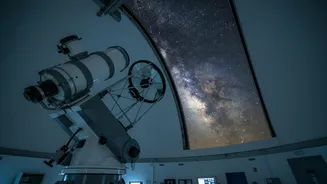
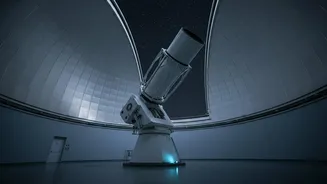
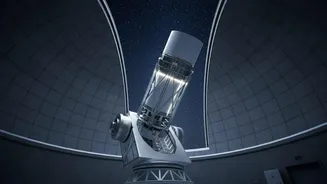
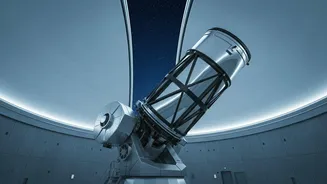
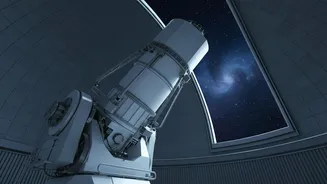
The first line of defence in planetary protection is a network of powerful survey telescopes. Projects like the Catalina Sky Survey in Arizona and Pan-STARRS in Hawaii are the planet's primary digital eyes on the sky. Unlike telescopes that stare at one
galaxy for hours, these instruments have wide fields of view and scan vast portions of the night sky repeatedly. On a clear night, a survey telescope will capture hundreds of images, taking short exposures of about 30 seconds each. This rapid-fire photography is designed not to admire the static beauty of the cosmos, but to catch anything that moves.
Playing 'Spot the Difference' in the Stars
The core method for finding a new asteroid is surprisingly simple in concept: look for a dot of light that isn't where it used to be. Computers take a series of images of the same patch of sky, captured several minutes apart, and digitally subtract them from one another. The distant stars and galaxies remain in fixed positions and cancel each other out, but an asteroid, being much closer, will have moved along its orbit. This movement reveals it as a point of light that appears in one place and then another. Automated software flags these moving specks as potential new objects and checks them against a massive database of all known asteroids and comets. If there's no match, the object is added to a confirmation list for further scrutiny.
From Candidate to Confirmed Asteroid
A single sighting isn't enough to announce a discovery. The potential new object is posted on the Near-Earth Object Confirmation Page, which is managed by the Minor Planet Center (MPC). This organisation, sanctioned by the International Astronomical Union, serves as the world's clearinghouse for all data on small solar system bodies. Once an object is listed, a global call goes out to astronomers—both professional and amateur—to turn their own telescopes toward it. These follow-up observations are crucial. Each new measurement from a different observatory helps confirm the object is real and provides the data points needed to map its journey through space.
Mapping the Cosmic Highway
With several confirmed observations in hand, scientists at centres like NASA's Center for Near-Earth Object Studies (CNEOS) can begin the critical work of calculating the asteroid's orbit. By plotting the object's observed positions over time, they can determine its trajectory with high precision. This process allows them to model the asteroid's path forward in time, predicting where it will be weeks, years, and even decades from now. This constant refinement is key; the more data that comes in, the more accurate the orbital prediction becomes, reducing uncertainty about its future path relative to Earth.
What 'Passing Safely' Really Means
The term "near-Earth" can be misleading; space is incredibly vast. An asteroid is formally designated as "potentially hazardous" if its orbit brings it within about 7.5 million kilometres of Earth's orbit and it is larger than about 140 metres in diameter. This doesn't mean it will hit Earth, only that it warrants close monitoring. When scientists declare that an asteroid will pass "safely," it means their orbital calculations show with a very high degree of certainty that its trajectory will miss our planet and the dense rings of communications and navigation satellites in geostationary and other orbits. NASA's Planetary Defense Coordination Office (PDCO) is responsible for issuing these warnings and communicating the level of risk to the public and government agencies, ensuring that we are aware and prepared for any object that truly poses a threat.