

A Breakthrough in Our Cosmic Backyard
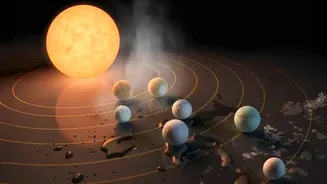
One of the most exciting recent developments comes from a planetary system known as PDS 70, located 370 light-years away. In September 2026, scientists using the JWST announced the detection of water vapour in the inner disk of this system. This is the region
where rocky, Earth-like planets are thought to form. While water has been found in other planet-forming disks, this was the first time it was spotted so close to the star in a system already known to be assembling planets. This discovery implies that any rocky worlds forming there would have access to water from the very beginning of their creation. It’s a monumental finding that moves the search for habitable worlds from a theoretical exercise to a direct investigation.
The Science of Starlight and Shadows
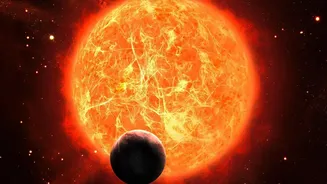
So, how does the telescope actually ‘see’ water so far away? The primary method is called transmission spectroscopy. Imagine a planet passing in front of its star, an event astronomers call a 'transit'. As the planet crosses, a tiny fraction of the starlight filters through the planet's atmosphere. Molecules within that atmosphere—like water vapour, methane, or carbon dioxide—absorb very specific wavelengths, or colours, of light. By capturing the light that passes through, the JWST can analyse which colours are missing. These missing slivers of light act like a chemical barcode, telling astronomers exactly what the atmosphere is made of.
An Eye for the Invisible
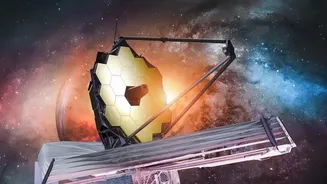
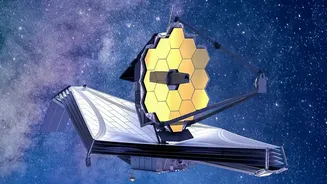
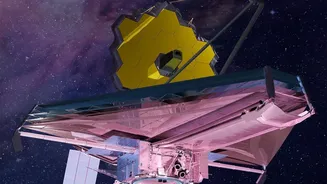
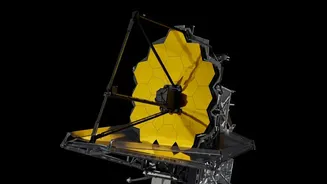
The James Webb Space Telescope is uniquely equipped for this task because it sees the universe in infrared light. This range of light is invisible to the human eye but is perfect for atmospheric studies because molecules like water have strong absorption features in the infrared spectrum. When the telescope stares at a transiting exoplanet, its powerful instruments, such as the Near-Infrared Spectrograph (NIRSpec) and Mid-Infrared Instrument (MIRI), spread the starlight into a rainbow-like spectrum. The distinctive pattern of dips and gaps in this spectrum reveals the presence and even the amount of water vapour. It’s a method so precise that it can detect trace gases from light-years away.
Not Just Water, but Clouds of Sand
The telescope's capabilities have led to other surprising discoveries. On the exoplanet WASP-107b, a 'fluffy' world 200 light-years away, JWST not only confirmed water vapour but also detected sulfur dioxide and, remarkably, clouds made of fine silicate particles—essentially, sand. This was the first time scientists could identify the specific chemical composition of clouds on an exoplanet. Such findings are crucial because they provide a more complete picture of an exoplanet’s climate and chemistry. The absence or presence of certain chemicals, like the surprising lack of methane on WASP-107b, can offer clues about a planet's internal temperature and evolution.
The Dawn of a New Era
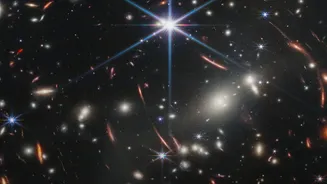
These deep-field studies are more than just isolated discoveries; they represent a fundamental shift in astronomy. Before JWST, scientists could barely confirm a planet's existence and mass. Now, they are dissecting the chemistry of alien atmospheres with stunning clarity. Each detection of water, whether on a hot gas giant or in the planet-forming disk around a young star, refines our understanding of how planetary systems form and evolve. While finding water vapour doesn't automatically mean finding life, it is a critical first step. It helps astronomers identify the most promising candidates for worlds that might have the right conditions for life to arise.