




A Thermometer for the Moon
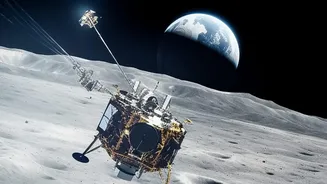
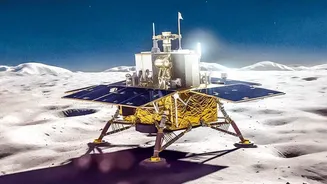
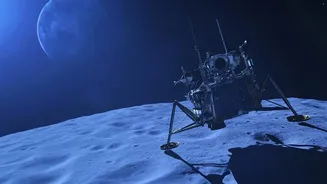
At the heart of this discovery is a brilliant piece of Indian engineering: the Chandra’s Surface Thermophysical Experiment, or ChaSTE. Developed by teams at the Space Physics Laboratory and the Physical Research Laboratory, ChaSTE is essentially a high-tech
thermometer designed to probe the lunar soil. It consists of a slender probe that can penetrate up to 10 centimetres into the Moon’s surface, equipped with 10 individual temperature sensors along its length. Its mission was simple but profound: to create the first-ever temperature profile of the lunar south pole's topsoil, helping scientists understand how the Moon's surface behaves thermally. This wasn't just another measurement; it was the first time such an in-situ profile had ever been taken in this unexplored region of the Moon.
Uncovering a Fluffy, Insulating Blanket
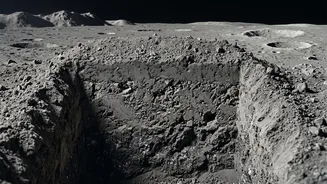
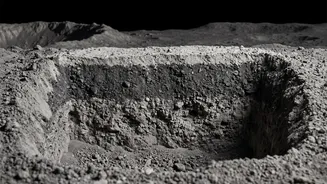
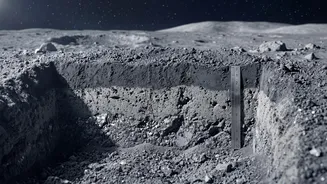
As the ChaSTE probe pushed into the ground at the Shiv Shakti Point landing site, it sent back startling data. At the surface, the temperature was a balmy 50-60 degrees Celsius. But just 8-10 centimetres below, the temperature plummeted to a frigid minus 10 degrees Celsius. This dramatic drop of nearly 70 degrees over such a short distance pointed to one conclusion: the topmost layer of the lunar surface is an incredibly effective insulator. The material was not conducting heat downwards, but instead acting like a protective thermal blanket. Analysis revealed the reason for this is its extreme porosity. The uppermost 3 centimetres of the soil, technically known as regolith, has an estimated porosity of 80 percent. That means only 20 percent of its volume is solid material, while the rest is empty space, which in the vacuum of the Moon, prevents heat from transferring easily.
More Than Just Dust
This 'lunar soil' is more accurately called regolith, a layer of fine rock fragments, dust, and glassy particles created over billions of years by relentless micrometeorite impacts. Unlike soil on Earth, which is weathered by wind and water and contains organic matter, lunar regolith is sharp, abrasive, and dry. The ChaSTE data further revealed that this regolith isn't uniform. Instead, it’s layered like a cake. The top 3 cm is a highly porous 'fluff', followed by a slightly denser layer from 3 to 6 cm, and a much more compacted layer below that. The bulk density increases from around 600 kg per cubic metre at the top to about 1,500 kg per cubic metre just 10 cm down. For a future astronaut, it might feel like walking on dry flour that quickly turns into dense, stiff clay just a few inches deeper.
Why This Finding is a Game-Changer
This discovery is far more than a scientific curiosity; it has profound implications for the future of lunar exploration and habitation. The highly insulating nature of the topsoil is a massive advantage for building future lunar bases. Structures could be built just a few feet underground to be naturally protected from the extreme temperature swings on the lunar surface, which can vary by hundreds of degrees between day and night. This would drastically reduce the energy needed for heating and cooling. Furthermore, understanding the soil's properties—its porosity, density, and stickiness—is crucial for designing rovers that won't get stuck, building stable landing pads, and developing excavation equipment. The porous structure might also influence how water ice, a critical resource, is stored or lost from beneath the surface.