



Drowning in Data
Modern space missions are generating information on an unprecedented scale. NASA's Earth observation archives already hold over 150 petabytes of data, a figure expected to grow significantly by 2030. Telescopes, orbiters, and rovers collect complex datasets
faster than they can be transmitted to Earth or reviewed by scientists. This creates a bottleneck where potential discoveries can remain hidden for years within unanalyzed archives. Without a new approach, the sheer volume of information threatens to outpace our ability to find meaning in it. This is where artificial intelligence becomes less of a futuristic concept and more of a present-day necessity, helping to shrink the time between data collection and scientific insight.
The AI Co-Pilot
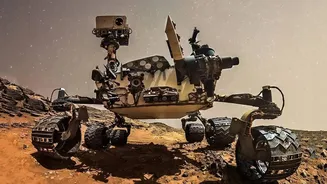
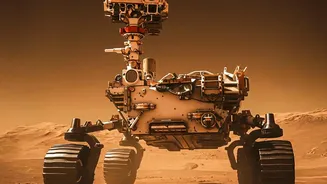
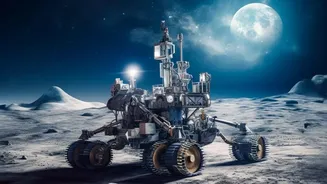
One of the most immediate applications of AI is making spacecraft more autonomous. For missions to distant planets like Mars, communication delays can be 20 minutes or longer each way, making real-time human control impossible. AI allows spacecraft to make their own decisions. For example, the Perseverance rover on Mars uses AI to navigate treacherous terrain independently, analyzing images to identify and avoid hazards. The rover has performed nearly 90% of its driving autonomously. This intelligence extends to science operations, with AI helping rovers identify promising rock samples for analysis. Beyond rovers, AI is being used to manage satellite constellations, predict system failures, and even track orbital debris to prevent collisions.
An Artificial Intelligence for Science
Beyond just operating spacecraft, NASA is leveraging AI as a core tool for scientific discovery. Machine learning algorithms are being trained to sift through enormous datasets to find patterns that humans might miss. NASA's ExoMiner, a deep learning system, analyzed data from the Kepler Space Telescope and successfully identified 301 new exoplanets. AI is also being used to accelerate the search for cosmic events like supernovae and gravitational waves. In a recent development, NASA announced its participation in the Genesis Mission, a national initiative to use AI to tackle major scientific challenges by connecting data from different missions and fields of study to reveal new discoveries. This initiative aims to reduce analysis times from years to days, accelerating breakthroughs.
Challenges on the Final Frontier
Integrating AI into critical space missions is not without significant hurdles. The harsh environment of space, with its extreme radiation and temperatures, can cause electronic components to fail. Standard commercial AI processors are not built to withstand these conditions, and radiation-hardened alternatives have historically been much less powerful. To address this, NASA is developing new, high-performance, radiation-tolerant computer chips that can deliver a massive leap in computational speed, enabling real-time AI processing far from Earth. There are also cybersecurity concerns, as AI systems could become targets for attacks that might compromise a mission. Building trust in these autonomous systems and ensuring they are reliable and secure is a key focus for engineers and mission planners.