


The Grand Celestial Alignment
A lunar eclipse is a beautiful and simple cosmic alignment. It happens when the Sun, Earth, and Moon line up perfectly, with our planet positioned directly in the middle. This formation causes Earth to cast its shadow onto the Moon, dimming our celestial
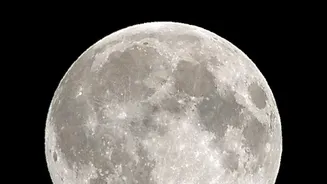
neighbour over a few hours. This can only occur during a full moon, when the Moon is on the opposite side of Earth from the Sun. However, an eclipse doesn't happen every full moon. The Moon’s orbit is slightly tilted, so it usually passes just above or below Earth's shadow. Only when the alignment is just right does the Moon glide through the shadow, creating the spectacle we call a lunar eclipse.
Understanding Earth's Two Shadows
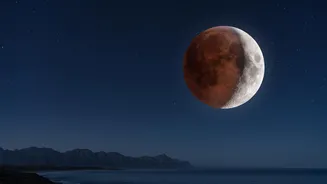
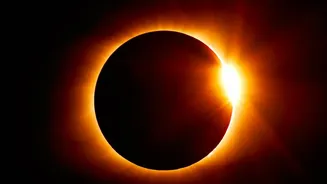
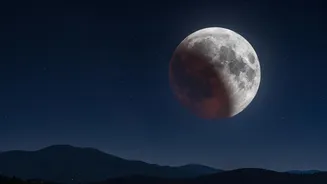
To understand what you see during an eclipse, it helps to know that Earth’s shadow isn’t uniform. It has two parts: a faint, outer shadow called the penumbra, and a dark, inner shadow called the umbra. When the Moon passes only through the penumbra, it's a penumbral eclipse, which causes such a subtle dimming that most people don't even notice it. When part of the Moon enters the umbra, it's a partial lunar eclipse. This is much more dramatic, appearing as if a dark bite has been taken out of the lunar disc. A total lunar eclipse occurs when the entire Moon is engulfed by the umbra, the darkest part of the shadow.
The Science of the 'Blood Moon'
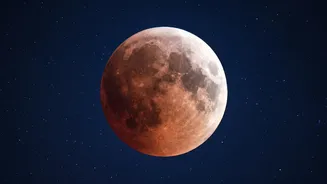
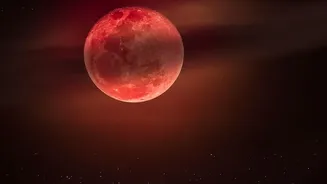
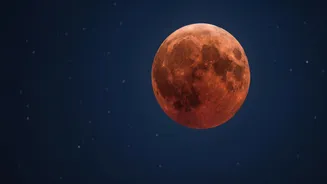
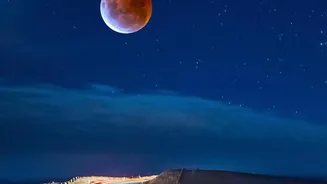
During a deep partial or total lunar eclipse, the Moon often takes on a spooky, reddish-orange glow, earning it the popular nickname “Blood Moon.” This isn't a sign of anything ominous, but rather a beautiful trick of the light explained by a phenomenon called Rayleigh scattering. As the Moon sits in Earth’s shadow, the only sunlight reaching it is light that has first passed through our planet’s atmosphere. Earth’s atmosphere scatters the shorter, blue wavelengths of light, but the longer, red wavelengths pass through more easily. This red-orange light is then bent, or refracted, toward the Moon. In essence, you're seeing the light of all the sunrises and sunsets on Earth being projected onto the lunar surface at once. The exact shade of red depends on the amount of dust and clouds in Earth’s atmosphere at the time.
Why India Will Miss This Week's Event
The partial lunar eclipse on August 28, 2026, is an unusually deep one, with Earth's shadow set to cover about 96% of the Moon's surface, making it an 'almost total' eclipse. However, skywatchers in India will not be able to witness this event directly. A lunar eclipse is only visible from the night side of Earth—any location where the Moon is above the horizon during the event. This eclipse will occur during daytime hours in India, meaning the Moon will be below the horizon and out of sight for the entire duration. While it will be visible across the Americas and parts of Europe and Africa, Indian stargazers will have to rely on livestreams to catch a glimpse.
Mark Your Calendars for the Next Show
While we miss out on the August event, there is good news for astronomy enthusiasts in India. The very next lunar eclipse of 2026 will be visible across the country. A significant partial lunar eclipse is set to occur on the night of September 7-8, 2026. This event will see a large portion of the Moon pass through Earth's dark umbra, offering excellent viewing opportunities from all over India. Unlike solar eclipses, lunar eclipses are perfectly safe to view with the naked eye, so no special equipment is needed. It will be a fantastic opportunity to witness this celestial shadow play firsthand.