




The Challenge of Flying Low
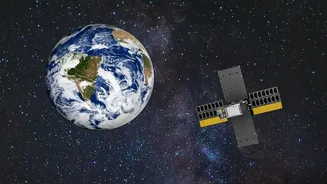
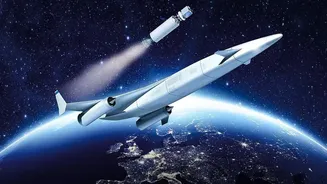
Satellite operators are increasingly drawn to Very Low Earth Orbit (VLEO), an altitude band just 150 to 300 kilometres up. Flying closer to home has enormous benefits: Earth observation satellites can capture much higher-resolution images, and communication
constellations can offer lower latency and faster service. The problem is that even at this altitude, the atmosphere isn't completely gone. There are enough residual air molecules to create significant aerodynamic drag, which slows a satellite down and causes its orbit to decay. To stay aloft, satellites must constantly fire thrusters to counteract this drag. This requires carrying propellant, typically xenon gas for highly efficient electric thrusters. But once the propellant runs out, the mission is over. The European Space Agency's GOCE satellite, which flew at just 250 km, was a prime example; its groundbreaking mission ended precisely when its 40 kg of xenon was exhausted. This fuel dependency makes long-term VLEO missions commercially unviable.
Turning a Problem Into Propellant
Air-breathing electric propulsion (ABEP) systems offer an elegant solution by ingeniously using the drag-inducing atmosphere as a limitless source of propellant. The concept is both simple and incredibly complex. An ABEP-equipped satellite features a specially designed intake, or scoop, at its front. As the satellite speeds through the upper atmosphere at nearly 8 kilometres per second, this intake collects the sparse air molecules, primarily nitrogen and oxygen. These captured particles are then channelled into an electric propulsion system. Inside the thruster, the molecules are ionized—given an electric charge—and then accelerated by an electromagnetic field, creating a jet of plasma that is ejected out the back. This produces a small but continuous thrust, precisely enough to compensate for the atmospheric drag. The system effectively allows the satellite to "breathe" the air to stay in orbit, eliminating the need to carry its own propellant from Earth. All it requires is a steady supply of electricity, which is readily available from solar panels.
The Dawn of 'Infinite' Missions
By removing onboard propellant as a life-limiting factor, air-breathing propulsion unlocks the potential for virtually indefinite missions in VLEO. This is a complete paradigm shift for the satellite industry. A fleet of observation satellites could provide persistent, high-resolution monitoring of climate change, agricultural yields, or infrastructure without needing replacement every few years. Low-latency communication networks could be maintained and operated far more cost-effectively. Beyond just longevity, this technology promotes a more sustainable use of space. VLEO is a 'self-cleaning' orbit; the same drag that ABEP systems fight against will quickly pull any debris or defunct satellites back into the atmosphere where they burn up. This prevents the build-up of dangerous space junk that plagues higher orbits, a critical concern as constellations like Starlink continue to grow. Essentially, ABEP enables high-performance missions in an orbit that is inherently more responsible.
From Theory to Reality
While the concept has existed for decades, significant engineering hurdles have kept it in the realm of research and development. Designing an intake that can efficiently collect and compress hypersonic molecules is a major challenge. Furthermore, electric thrusters must be adapted to run efficiently on air instead of the noble gases they were designed for. Atomic oxygen in VLEO is also highly corrosive and can degrade critical thruster components over time. Despite these difficulties, progress is accelerating. In 2018, the European Space Agency successfully demonstrated the world's first ground test of a complete air-breathing thruster system, proving the core concept was viable. More recently, advancements in early 2026 saw an ESA-backed project successfully pass a key design review for a 'cathodeless' thruster. This innovative design removes one of the components most vulnerable to oxygen degradation, marking a critical step toward building robust, long-lasting systems ready for the rigours of space.