



A Boundary of Opposites
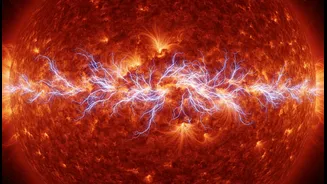
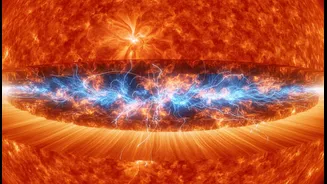
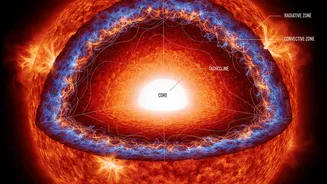
Imagine the Sun as a giant onion with several layers. The inner 70% is the radiative zone, where energy moves slowly outwards. The outer 30% is the convection zone, a roiling sea of hot plasma. Between these two vastly different regions lies the tachocline.
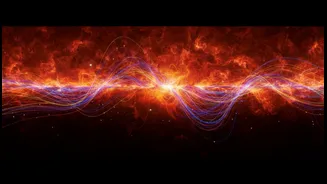
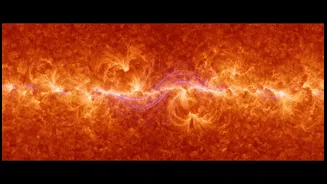
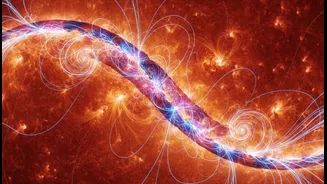
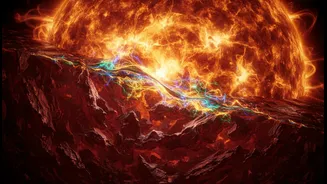
It's an incredibly thin boundary, making up less than 5% of the Sun's radius. In the radiative zone below, the Sun rotates like a solid ball. In the convection zone above, it spins faster at the equator than at its poles, a phenomenon called differential rotation. The tachocline is the shear layer where these two opposing rotation styles meet, creating immense physical stress.
The Engine of the Solar Cycle
This intense shear is what makes the tachocline so important. Many scientists believe it's the seat of the solar dynamo, the process that generates the Sun's massive magnetic field. The stretching and twisting motions within the tachocline are thought to amplify and organize magnetic fields. This magnetic energy builds up over time and is eventually released, driving the Sun's 11-year activity cycle. This cycle governs the appearance of sunspots, which are areas of intense magnetic activity on the surface. Essentially, the tachocline acts like a powerful generator, storing and then unleashing the energy that dictates the Sun's rhythm.
How Scientists Study the Unseen
Since we can't see the tachocline directly, scientists rely on a technique called helioseismology. This field of study is like seismology on Earth, but instead of using earthquakes, it uses the sound waves that constantly reverberate through the Sun. By observing the subtle oscillations on the Sun's surface, researchers can map out the structure and dynamics of the deep interior, including the location and properties of the tachocline. These observations, gathered by instruments on spacecraft like SOHO and ground-based networks, have been crucial in revealing this hidden layer and its characteristics.
Practical Impact on Earth
What happens in the Sun's tachocline doesn't stay in the tachocline. The magnetic field it generates powers space weather, which can have significant effects on Earth. Violent events like solar flares and coronal mass ejections (CMEs) are born from the magnetic energy that originates in the Sun's interior. When this energy is unleashed, it can send vast clouds of charged particles hurtling through space. If aimed at Earth, these events can disrupt satellite communications, damage power grids, interfere with GPS signals, and pose a risk to astronauts in orbit. Understanding the tachocline is therefore a critical part of improving our ability to predict this potentially hazardous space weather.
Remaining Questions and Future Research
Despite decades of study since its discovery in 1992, the tachocline still holds many mysteries. One of the biggest questions is why it is so surprisingly thin. Standard fluid dynamics models suggest it should be much thicker, or have dissipated over the Sun's lifetime. Recent computer simulations suggest the Sun's own magnetic field may play a role in containing the layer and keeping it thin. However, there is still debate, with some models suggesting the dynamo process may be located closer to the surface than previously thought. Scientists are also working to understand the precise mechanisms of magnetic field storage and the instabilities that trigger its release. Solving these puzzles is a major goal for solar physics, as it promises not only a deeper understanding of our own star but also of the countless other stars in the universe.