
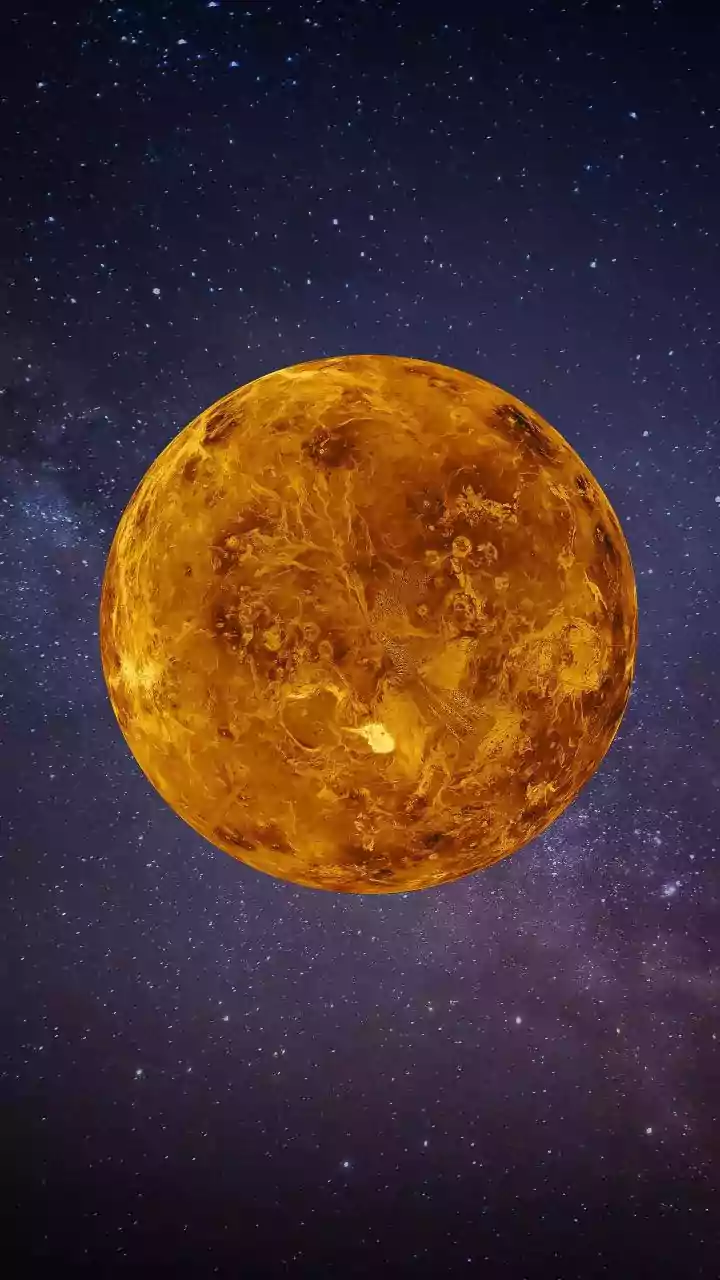





A Planet of Paradoxes
Venus is often called Earth's twin due to their similar size and composition, but the similarities end there. It's a world of extremes: surface temperatures hot enough to melt lead, crushing atmospheric pressure, and clouds of sulfuric acid. Yet, its
most mind-bending feature is its peculiar sense of time. On Earth, we are accustomed to a simple rhythm: 365 days in a year. On Venus, this fundamental relationship is flipped on its head. This isn't just a quirky fact; it's a clue to the planet's violent and mysterious history.
Defining Time on an Alien World
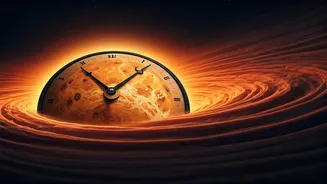
To understand this paradox, we first need to define what a 'day' and 'year' mean. A year is straightforward: it's the time a planet takes to complete one orbit around the Sun. For Venus, this is about 225 Earth days. A day, however, is more complex. A 'sidereal day' is the time it takes for a planet to complete one full rotation on its axis. And this is where Venus gets weird. It takes Venus a staggering 243 Earth days to spin around just once. Therefore, its day (243 Earth days) is longer than its year (225 Earth days). Funnily enough, its 'solar day'—the time from one sunrise to the next—is about 117 Earth days, because the planet is orbiting the sun in the opposite direction to its spin.
Spinning the Wrong Way
Not only does Venus spin incredibly slowly, it also spins backwards. All planets in our solar system (except for a wobbly Uranus) orbit the Sun and rotate on their axis in the same counter-clockwise direction. This is called prograde motion. Venus, however, has a retrograde rotation, spinning clockwise. If you could stand on Venus, you would see the Sun rise in the west and set in the east. Scientists believe this backward spin is a key part of the puzzle. The leading theories suggest that either a massive object, perhaps another planet, collided with Venus in the distant past, reversing its spin, or that the gravitational pull of the Sun on its incredibly dense atmosphere created a 'tidal' effect that slowed its rotation to a halt and then ever so slightly reversed it over billions of years.
The Culprit: A Runaway Atmosphere
The most compelling theory for Venus's slow spin points to its suffocating atmosphere. Venus's atmosphere is about 90 times denser than Earth's, composed almost entirely of carbon dioxide. This creates a runaway greenhouse effect, trapping heat and creating immense surface pressure. This thick, heavy atmosphere doesn't just sit there; it's a dynamic, powerful force. Think of it like trying to run in a swimming pool versus running in open air. The thick Venusian atmosphere creates a powerful drag on the planet's surface, acting like a giant brake. Over billions of years, these atmospheric 'tides'—bulges created by solar heating—have likely slowed down the planet's rotation to its current glacial pace.
What a Venusian 'Day' Feels Like
The consequences of this cosmic clock are profound. With a single day lasting months, one side of the planet bakes under the relentless Sun for an extended period, while the other side is plunged into an equally long night. However, because the atmosphere is so thick and efficient at circulating heat, the temperature difference between the day and night sides is surprisingly minimal. The entire planet remains a scorching, uniform oven, regardless of where the Sun is in the sky. This bizarre temporal rhythm, driven by its unique rotation and atmosphere, makes Venus one of the most inhospitable yet fascinating places in our solar system.