






Deconstructing the '2026 Shock'
First, let's address the elephant in the room. Does the India Meteorological Department (IMD) issue specific year-by-year monsoon forecasts this far in advance? The short answer is no. The IMD, the country's official weather agency, provides detailed
seasonal forecasts for the upcoming monsoon in two stages—one in April and an update in late May. These forecasts are for the immediate year only. A prediction for 2026 is not part of their standard operational forecasting. So, where does such a claim come from? It likely originates from academic climate models or long-term statistical studies that identify potential patterns or cycles. These are research tools for understanding possibilities, not official public warnings. A specific year like 2026 appearing in a headline is often an oversimplification of a researcher’s work on multi-decadal trends.
The Monsoon's Global Puppet Masters
To understand why forecasting is so tricky, you have to know what pulls the monsoon's strings. The Indian monsoon isn't a local affair; it's a massive weather system influenced by conditions across the globe. The most famous influencer is the El Niño-Southern Oscillation (ENSO) in the Pacific Ocean. A strong El Niño (warming of the Pacific) is often, but not always, linked to a weaker Indian monsoon. Its counterpart, La Niña (cooling), is often associated with a stronger one. Then there's the Indian Ocean Dipole (IOD), a sort of tug-of-war between sea surface temperatures in the western and eastern Indian Ocean. A 'positive' IOD can boost the monsoon, sometimes even countering El Niño's negative effects. These phenomena have their own cycles, but predicting their exact timing and intensity years ahead is at the cutting edge of climate science, and still fraught with uncertainty.
How IMD Forecasts Actually Work
The IMD's forecasting is a sophisticated blend of art and science. They use a 'Multi-Model Ensemble' system, which means they don't rely on a single crystal ball. Instead, they run numerous complex mathematical simulations on supercomputers, each with slightly different starting conditions. These are known as dynamical models. They also use statistical models that analyse historical data to find relationships between past climate parameters and monsoon performance. By combining the outputs of these different models, the IMD arrives at a probabilistic forecast. They predict rainfall as a percentage of the Long Period Average (LPA), which is the average monsoon rainfall from 1971-2020 (87 cm). A 'normal' monsoon is defined as rainfall between 96% and 104% of the LPA. 'Below normal' is between 90% and 95%. This meticulous process is for the coming season, not for a date three years away.
The Real Story: Volatility is the New Normal
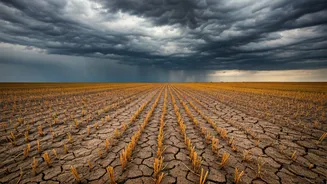
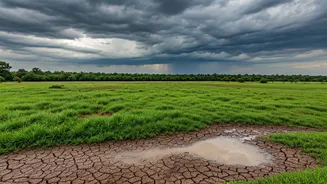
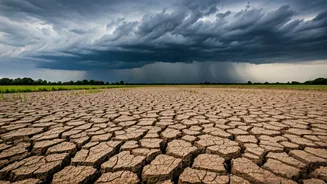
While a specific prediction for 2026 should be taken with a large grain of salt, it points to a much more important and scientifically supported truth: climate change is making our monsoons more erratic. This is the real trend to watch. Scientists have observed that while the total volume of rain in a season might remain near normal, its distribution is changing. We are seeing longer dry spells punctuated by short, intense bursts of extreme rainfall. This pattern is disastrous for agriculture. Long dry periods can wither young crops, while sudden deluges can cause flooding and soil erosion, washing away what's left. The number of 'heavy' and 'very heavy' rainfall days is increasing, a clear signature of a warming climate's impact on weather patterns.
Why We Must Prepare, Not Panic
A 'below-normal' monsoon has tangible, widespread consequences. Over half of India's farmland is rain-fed, meaning a weak monsoon directly impacts crop yields, particularly for Kharif crops like rice, soybean, and cotton. This can fuel food inflation and cause distress in the rural economy, where a majority of the population still derives its livelihood. It also affects the water levels in our major reservoirs, which are crucial for drinking water, irrigation during the dry season, and hydroelectric power generation. A deficit in monsoon rains can create a ripple effect that touches nearly every aspect of the Indian economy. Understanding this impact is why monsoon forecasting is treated with such national importance.