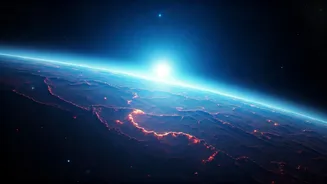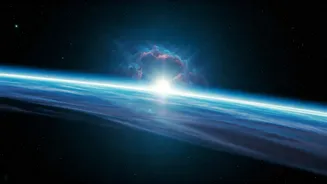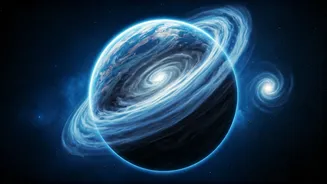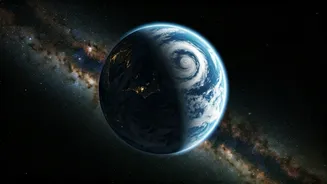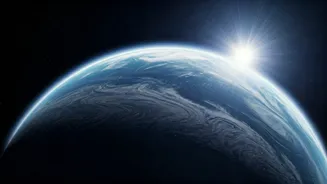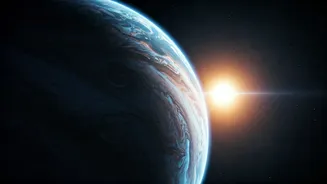



A Glimpse into an Alien Twilight
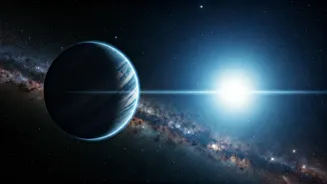
The 'twilight' in question isn't just a poetic term; it refers to a specific region of an exoplanet known as the terminator. This is the line that separates the permanent, scorching hot dayside of a tidally locked planet from its frigid, permanent nightside.
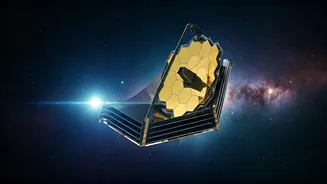
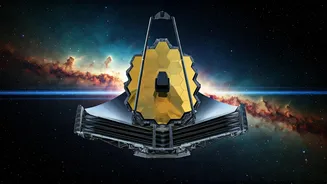
By studying the light from a parent star as it filters through this twilight zone during a planet's transit, astronomers can decipher the chemical makeup of its atmosphere. The James Webb Space Telescope (JWST), with its unparalleled sensitivity, has made this technique more powerful than ever, providing a detailed look at the chemistry of worlds hundreds of light-years away.
The Curious Case of K2-18 b
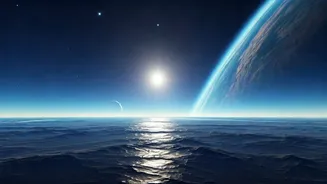
The planet causing all the commotion is K2-18 b, an exoplanet about 120 light-years from Earth. It's more than eight times the mass of our planet, placing it in a category of worlds called 'sub-Neptunes'. K2-18 b has become a primary target for Webb because previous observations suggested it could be a 'Hycean' world—a hypothetical type of planet with a liquid water ocean beneath a hydrogen-rich atmosphere. This combination makes it a tantalizing candidate in the search for habitable environments beyond Earth. The initial Webb observations were thrilling, confirming the presence of carbon-bearing molecules like methane and carbon dioxide, key ingredients for life as we know it.
A Missing Piece of the Puzzle
While the detection of methane and carbon dioxide was consistent with the Hycean model, it was the absence of another chemical that has sent scientists back to the drawing board. According to existing models of these ocean worlds, an atmosphere rich in hydrogen should also contain a significant amount of ammonia. Photochemical reactions would naturally produce it. Yet, Webb's sensitive instruments found a distinct shortage of ammonia in K2-18 b's atmosphere. This discrepancy—this missing chemical—suggests that our understanding of the atmospheric chemistry on Hycean worlds is incomplete or perhaps fundamentally flawed. The puzzle deepens an already intriguing picture, as Webb's data also showed a possible hint of dimethyl sulfide (DMS), a molecule that on Earth is overwhelmingly produced by life, particularly marine phytoplankton.
Rethinking 'Habitable' Worlds
This single, stubborn fact—the lack of ammonia where it should be—is forcing a major reassessment of what constitutes a habitable Hycean planet. It means the conditions on K2-18 b may not be exactly what we thought. Perhaps the ocean is much hotter than predicted, or maybe there's an unknown geological or chemical process at play that removes ammonia from the atmosphere. Scientists are now tasked with building new models that can account for an atmosphere with methane and carbon dioxide, but no ammonia. This process of discovery and revision is the very essence of science. Each new piece of data from Webb doesn’t just answer questions; it provides better, more refined questions to ask next.