
Cosmic Nurseries in High Definition
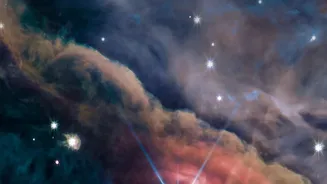
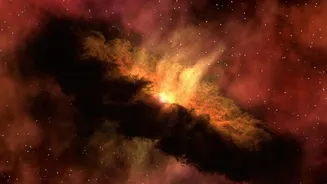
Deep in space, vast, cold clouds of gas and dust known as molecular clouds serve as stellar nurseries. For a long time, these regions, like the famous Orion Nebula, were obscured by the very dust that gives them life. But the latest generation of space observatories,
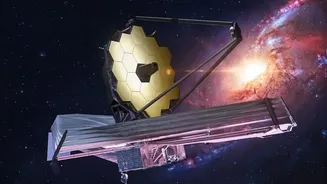
particularly the James Webb Space Telescope (JWST), can see through this haze using infrared light. This has allowed astronomers to witness the earliest stages of star and planet formation with breathtaking clarity. Instead of fuzzy blobs, we now see intricate structures, protostars pulling in surrounding gas, and powerful jets of material being ejected from these infant suns. It’s like finally getting a clear look inside the delivery room for stars.
The Blueprint of a Solar System
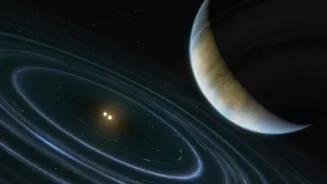
Around these young stars, leftover gas and dust form a swirling platter called a protoplanetary disk. This is the literal construction site where planets are built. Over millions of years, dust grains in the disk collide and stick together, growing into larger bodies called planetesimals, which eventually form planets. JWST's sharp vision has allowed astronomers to see the structures within these disks—gaps, rings, and spirals—that strongly suggest planets are actively forming and carving out their orbits. Some recent discoveries have even captured what appears to be the very earliest moment of planet formation, where hot minerals are just beginning to solidify out of the gas near a star, a process never witnessed outside our solar system before.
Finding the Ingredients for Life
Perhaps the most profound discoveries have been in astrochemistry. Telescopes have detected a rich soup of complex organic molecules in these star-forming regions, frozen on dust grains. These include molecules like methanol, ethanol, and acetaldehyde, which are precursors to the chemicals needed for life. Finding these building blocks in the raw material of planets suggests that the ingredients for life are not a rare cosmic accident but a common feature of star formation. They form on icy dust grains long before planets even take shape and are later delivered to these new worlds. This means that planets may be born 'pre-loaded' with the essential components to get life started.
Rethinking Planetary Timelines
These new observations are also challenging and refining long-held theories. For example, planet formation might be a race against time, as powerful stellar winds and jets can blow away the gas in a protoplanetary disk, cutting off the supply for forming gas giants like Jupiter. However, other discoveries show that some protoplanetary disks can last much longer than previously thought—up to 30 million years instead of the expected 10 million—giving planets more time to grow and settle into stable orbits. Furthermore, studying 'extreme debris disks' where violent collisions between planet-sized objects occur gives us insight into the chaotic final stages of planet formation, similar to the giant impact thought to have formed our own Moon.
A Mirror to Our Own Past
Ultimately, studying these distant, infant solar systems is like looking at a photo album of our own cosmic family history. When astronomers see a disk of gas and dust condensing around a young star, they are seeing a system that resembles what our solar system looked like 4.5 billion years ago. By identifying the chemical ingredients, observing the timelines, and mapping the structures of these nascent planetary systems, we can piece together the story of our own origins. We are moving from theories and models to direct observation, turning the abstract question of 'Where did we come from?' into a scientific investigation with increasingly clear answers.