



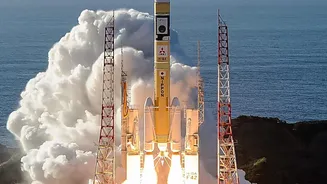

The New Space Race Is Private
For decades, space in India was synonymous with the Indian Space Research Organisation (ISRO). But a monumental shift is underway. Following landmark policy reforms in 2020 and the establishment of IN-SPACe, a regulatory body to nurture private participation,
a vibrant ecosystem of over 400 space startups has emerged. Leading the charge are companies like Skyroot Aerospace and Agnikul Cosmos. Skyroot made history in July 2026 by successfully launching its Vikram-1 rocket, becoming the first private Indian company to place satellites into orbit. This achievement made India only the third country, after the US and China, with private orbital launch capability. This isn't just about one successful mission; it signals the operational start of a new commercial launch industry in the country.
A Traffic Jam to Orbit Eases Up
For satellite companies, both in India and abroad, one of the biggest bottlenecks has been launch availability. Getting a spot on a rocket often involves long waits and scheduling uncertainty, forcing some Indian firms to look to international providers like SpaceX. The arrival of domestic private launchers changes this equation dramatically. More rockets mean more frequent launch opportunities. This increased cadence is crucial for satellite constellation operators who need to deploy multiple satellites and replace older ones to maintain their services. With Skyroot already preparing for its next flight and Agnikul advancing its own Agnibaan rocket, the era of launch scarcity in India could soon be over, giving satellite companies more control over their deployment timelines.
The Small Satellite Sweet Spot
The global space economy is increasingly driven by small satellites—compact, cost-effective spacecraft used for everything from Earth observation to communications. India's private rockets, like the Vikram-1 which can carry around 350 kg to Low Earth Orbit, are perfectly tailored for this booming market. Instead of 'ridesharing' on a large rocket with a primary payload dictating the orbit and schedule, small satellite operators can book dedicated flights on these smaller vehicles. This offers greater flexibility and precision, allowing them to get their hardware exactly where it needs to be, when they need it. As the Indian small satellite market is projected to grow significantly, reaching nearly $1 billion by 2030, this dedicated launch capability is a critical enabler.
Driving Down the Cost to Orbit
Historically, launching from India has been perceived as expensive on a per-kilogram basis compared to competitors like the US. However, the introduction of private competition is expected to exert significant downward pressure on prices. Startups, driven by a profit motive and innovative manufacturing techniques like 3D printing, are inherently focused on efficiency. Agnikul, for instance, believes its reusable rocket technology could eventually reduce launch costs by up to 80%. The government is also catalysing this shift through IN-SPACe, which offers pricing support policies to make launches more affordable for domestic companies. For satellite companies, this translates directly to a lower cost of doing business, making new ventures viable and existing services more profitable.
Attracting Global Customers
The impact of India's private rocket boom extends far beyond its borders. A competitive, multi-provider launch market enhances India's position as a global space hub. International satellite companies are always seeking reliable, cost-effective launch options. With a proven track record beginning with Vikram-1's success, Indian private launchers can now compete for a slice of the international market. This not only brings in foreign revenue but also strengthens India's strategic and diplomatic standing, offering launch services to nations in the Indo-Pacific and Global South. The goal is to transform India from a country that launches its own satellites to a country that is a go-to destination for the world's satellite industry.
Challenges on the Launchpad
Despite the excitement, the road ahead has challenges. The primary hurdle for these new companies is to prove their reliability over multiple missions. One successful launch is a milestone, but satellite operators need a consistent and dependable track record before committing high-value assets. Furthermore, scaling up manufacturing to meet demand and achieving a high launch frequency will test their operational capabilities. They also face stiff competition from established global players who benefit from immense scale and proven reusability. While the potential is enormous, sustained success will depend on execution, continued innovation, and consistent financial backing in a capital-intensive industry.