






A Signal from the Void
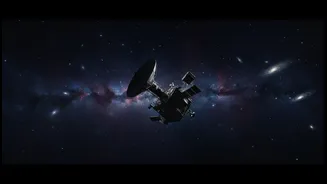
On June 23, 2026, flight controllers at the Johns Hopkins Applied Physics Laboratory confirmed they had received a signal from New Horizons. This wasn't just any signal; it was confirmation that the spacecraft had successfully roused itself from a 321-day
hibernation that began in August 2025. Given the immense distance, the message, travelling at the speed of light, took about 8 hours and 52 minutes to reach Earth. Mission Operations Manager Alice Bowman reported that weekly status updates during the long sleep were all 'green', indicating the probe remained in perfect health while dormant.
Why Does It Sleep?
Putting a spacecraft into hibernation is a crucial strategy for long-haul missions. It conserves the limited power from its radioisotope thermoelectric generator—a form of nuclear battery—and reduces wear and tear on its systems. During these quiet periods, many of its complex systems are powered down, but it's not a total slumber. Several science instruments continue to passively collect valuable data about its surroundings, effectively turning the probe into a silent sentinel gathering information on space dust and charged particles in the far reaches of the solar system. This wake-up was its 23rd hibernation period since 2007.
A Landmark Journey So Far
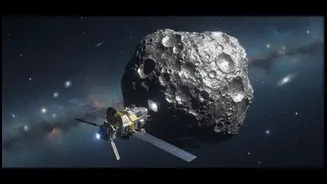
Launched in 2006, New Horizons holds the record for the fastest human-made object ever launched from Earth. Its primary mission was to conduct the first-ever flyby of Pluto. In July 2015, it did just that, revealing the dwarf planet as a stunningly complex world with nitrogen glaciers and vast mountains of water ice. But its work wasn't done. On New Year's Day 2019, it flew past Arrokoth, a snowman-shaped object in the Kuiper Belt, setting the record for the most distant object ever explored by a spacecraft.
Exploring the Kuiper Belt
New Horizons is currently cruising through the Kuiper Belt, a vast, donut-shaped region beyond Neptune's orbit filled with icy remnants from the formation of our solar system. Think of it as a cosmic fossil record. While the famous asteroid belt between Mars and Jupiter is mostly rock, the Kuiper Belt is far larger and populated with icy bodies. Even while hibernating, New Horizons gathered data, and now that it's awake, the mission team will begin the slow process of downlinking months of stored observations about this mysterious 'third zone' of our solar system.
What's Next on the Horizon?
With no new flyby target currently in reach, New Horizons' extended mission has shifted focus. It now serves as a unique deep-space observatory. Its immediate tasks include sending back all the data gathered during hibernation and allowing engineers to perform health checks. Soon, its instruments, like the Alice ultraviolet spectrograph, will be used to study the heliosphere—the vast bubble of charged particles blown outward from our Sun. The spacecraft is helping scientists understand where our Sun's influence ends and interstellar space begins, a boundary it is predicted to cross sometime between 2029 and 2040. Its mission has been extended until it exits the Kuiper Belt in the late 2020s, ensuring this intrepid explorer continues to send back postcards from the frontier.