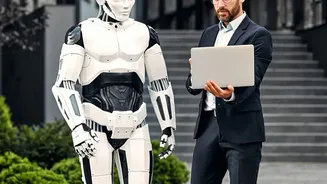







The fear that artificial intelligence will lead to mass unemployment is widespread. But a recent forecast from technology research firm Gartner offers a more optimistic view, predicting AI will create more jobs than it eliminates by 2030.
The Tale of the Numbers
According to
a report presented at the Gartner IT Symposium/Xpo in Barcelona, AI is projected to generate 10.6 million new jobs worldwide while displacing 8.9 million by the end of the decade. This results in a net increase of 1.7 million jobs. However, the story isn't just about creation and destruction. The report highlights a more significant trend: job transformation. While direct job losses from AI are expected to affect a relatively small percentage of the global workforce—between 0.4% and 1.8%—a much larger portion will see their roles evolve. Gartner estimates that by 2030, over 20% of all workers, or about 435.5 million people, will need to adapt to new ways of working as AI becomes more integrated into their daily tasks.
Where Will Jobs Be Lost and Gained?
The impact of AI will not be evenly distributed across industries. Gartner's analysis shows the technology sector will be a major engine of growth, with a projected net gain of 1.5 million jobs. Although nearly 70% of tech workers have high exposure to AI, the industry is expected to create 1.9 million roles while losing only 400,000. Asset-intensive industries, like manufacturing, are also forecast to see a net gain, with 6.4 million jobs created versus 6 million lost. In contrast, the public sector is expected to see a net decrease, losing 900,000 jobs while gaining only 400,000. The roles most at risk of displacement are those involving repetitive, data-driven tasks, such as data entry and administrative assistance, which are prime candidates for automation.
Augmentation, Not Just Replacement
Leading organizations view AI less as a tool for replacing employees and more as a catalyst for reinvention. The focus is shifting toward augmenting human capabilities, freeing up workers from mundane tasks to concentrate on areas where humans excel: critical thinking, creativity, and complex problem-solving. For example, an IT engineer might be freed from handling simple support tickets to focus on cybersecurity and complex infrastructure projects. This fusion of human and machine intelligence means that while many job titles may remain the same, the work done within those roles will change significantly. This transition will require one of the most significant workforce transformations in history, according to research from McKinsey.
The Rise of New and Hybrid Roles
The AI revolution is not just changing old jobs; it's creating entirely new ones. The World Economic Forum identifies AI and machine learning specialists, big data specialists, and cybersecurity professionals as some of the fastestest growing roles. Beyond purely technical positions, new 'hybrid' jobs are emerging. These include roles like AI prompt engineers, AI ethics officers, AI maintenance specialists, and AI literacy educators, who will be responsible for training teams on how to use these new tools effectively. Companies will need people who can manage and scale AI safely, ensuring it aligns with business goals and operates responsibly.
The consensus among analysts is that the biggest challenge ahead is not a scarcity of jobs, but a scarcity of the right skills. The World Economic Forum notes that while AI and big data are the fastestest growing technical skills, employers also highly value humancentric abilities like analytical thinking, creativity, resilience, and flexibility. As AI handles more routine cognitive tasks, human workers will be increasingly valued for their ability to define problems, interpret complex outputs, and exercise judgment. This highlights a critical need for widespread upskilling and reskilling. Workers and companies that invest in continuous learning will be best positioned to thrive in an AIpowered economy.