




The Ultimate Logistics Challenge
Sustaining human life on the Moon is one of the greatest logistical hurdles in exploration history. Every kilogram of supplies—from water and food to breathable air and rocket propellant—must be launched from Earth, a process that is astronomically expensive
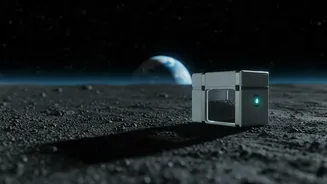
and complex. For a permanent base to be viable, astronauts cannot rely solely on resupply missions. The farther we venture into space, the more critical it becomes to live off the land. This principle, known as in-situ resource utilization (ISRU), is at the heart of NASA's strategy for making deep space exploration both affordable and sustainable. Instead of packing everything, the goal is to find and process local resources to create the essentials for survival and operations.
Mining for Air in Moon Dust
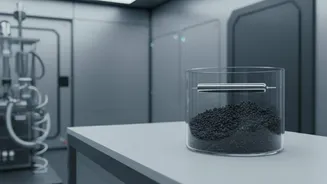
It may sound like science fiction, but the Moon's surface is surprisingly rich in a vital resource: oxygen. Lunar soil, or regolith, is made of about 45% oxygen by mass. This oxygen isn't free-floating in an atmosphere, but chemically locked inside minerals like silicon oxide, iron oxide, and aluminum oxide. The challenge lies in breaking these strong chemical bonds to release the breathable gas. NASA and its commercial partners are developing several methods to do this, with two primary techniques leading the way: molten regolith electrolysis and carbothermal reduction. Both processes involve heating the lunar dust to extreme temperatures, often above 1,600 degrees Celsius, to melt it into a molten state.
The Science of Brewing Oxygen
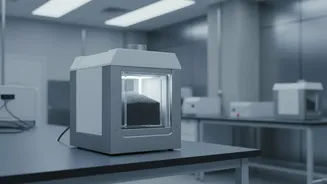
Molten regolith electrolysis works much like the electrolysis experiments you may have seen in a science class. Once the regolith is melted, an electric current is passed through the liquid. This splits the metal oxides, causing pure oxygen to bubble up at one electrode, where it can be collected. A valuable byproduct of this process is a mixture of molten metals that could be used for manufacturing or 3D printing construction materials for the lunar base. The other key method, carbothermal reduction, involves heating the regolith in a reactor and introducing a carbon source. This reaction pulls the oxygen out of the metal oxides to form carbon monoxide, which can then be processed to yield pure oxygen. Recent tests have successfully demonstrated this process in a vacuum, simulating the lunar environment and proving its potential for future Artemis missions.
The Teams Making It Happen
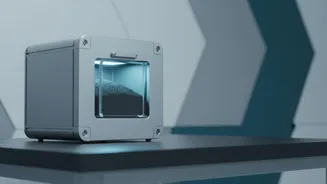
This groundbreaking work isn't happening in a vacuum. NASA's Johnson Space Center and Kennedy Space Center are leading projects like the Carbothermal Reduction Demonstration (CaRD). These efforts bring together government expertise with the innovation of private companies. Firms like Sierra Space and Blue Origin are developing their own reactors designed to operate on the lunar surface. Sierra Space, for example, has successfully tested a carbothermal reactor that can withstand the extreme temperature swings of the Moon's south pole. Meanwhile, Blue Origin's 'Blue Alchemist' program uses molten electrolysis to produce not only oxygen but also solar cells and wire from the metallic byproducts. These public-private partnerships are crucial for accelerating the technology needed for a sustainable lunar economy.
Fueling the Future of Exploration
The ability to generate oxygen on the Moon is a game-changer. Beyond providing breathable air for astronauts, oxygen is a key component of rocket propellant. A lunar base capable of producing its own propellant could function as a cosmic refueling station, dramatically reducing the cost of missions to Mars and beyond. Instead of launching a massive, fully-fueled spacecraft from Earth's deep gravity well, future missions could launch with less fuel and top up in lunar orbit. This capability transforms the Moon from a destination into a critical stepping stone for humanity's expansion across the solar system, making our presence in space not just a series of visits, but a permanent endeavor.