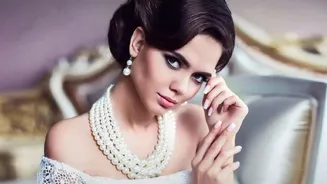

Your Essential Vintage Styling Toolkit
Before you begin twisting and pinning, gathering the right tools is essential. Most vintage styles are built with a surprisingly simple kit. You'll need a rat-tail comb for precise parting and backcombing, and plenty of bobby pins that match your hair
colour to secure your styles discreetly. Alligator or duckbill clips are perfect for holding sections while you work. For setting your hair, a good setting lotion or mousse applied to damp hair provides hold and longevity. A strong-hold hairspray is your final step to lock everything in place. Some stylists also recommend a soft bristle brush for smoothing and shaping your finished curls without causing frizz. While not essential for every style, hot rollers can speed up the process of creating a curly base.
The Foundation: Mastering the Pin Curl
The pin curl is the fundamental building block of countless vintage looks from the 1920s through the 1950s. It's a method of creating curls without heat. To start, take a small, damp section of hair about one to two inches wide. Beginning from the ends, roll the hair inward toward the scalp until it forms a tight coil. Secure this flat curl against your head using a bobby pin or a single-prong clip. Repeat this process across your entire head. The direction you roll the curls and the pattern you set them in will determine the final look. For a classic, soft wave, many tutorials recommend letting the pin curls dry completely—ideally overnight wrapped in a silk scarf—before brushing them out gently.
Iconic Look 1: 1940s Victory Rolls
Perhaps the most recognizable style of the 1940s, victory rolls create a dramatic, elegant frame for the face. This style works best on hair that hasn't been freshly washed, as the natural oils provide better grip. Start by creating a part and sectioning off the front portions of your hair on either side, from your hairline to behind your ears. Take one section, hold it straight up, and backcomb the underside to create volume. Then, holding the ends, begin rolling the hair inward toward your head, forming a large loop. Once the roll is against your scalp, secure it firmly with bobby pins, hiding them inside the roll. Repeat on the other side for a symmetrical look. Finish with a generous mist of hairspray to hold the shape.
Iconic Look 2: Simplified 1960s Beehive
The beehive delivers dramatic height and was a defining look of the 1960s. A simplified, modern version is surprisingly achievable. Start by sectioning off the hair at the crown of your head. To create volume, heavily backcomb or 'tease' the underside of this section with a comb. For extra height without extreme teasing, you can place a 'hair rat' or a small foam bun form underneath the section at the crown. Once you have the desired volume, gently smooth the top layer of hair over the teased section or hair form to hide the backcombing. Gather the smoothed hair and pin it at the back of your head, creating the characteristic 'bump'. The rest of your hair can be left down or styled into a simple updo.
Iconic Look 3: The 1950s High Ponytail
The 1950s ponytail was a popular youthful style, often worn high on the head with a playful flick at the end. To achieve this look, start by teasing the hair at the crown to create some volume before brushing your hair back. Gather your hair into a high ponytail and secure it with an elastic. For a polished touch, take a small strand of hair from the ponytail and wrap it around the elastic to conceal it, securing the end with a bobby pin underneath. To get the classic 'fifties flip', use a large-barrel curling iron to curl just the ends of the ponytail, rolling them upward and outward. Brushing the curled tail with a grooming brush can help create a soft, uniform flip.