



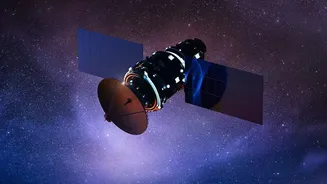
The Constant Drag in Low Orbit
Satellite operators love low Earth orbit (LEO) and especially Very Low Earth Orbit (VLEO), an altitude range roughly between 150 and 450 kilometres. Being closer to the ground means lower signal latency for internet services, higher-resolution images
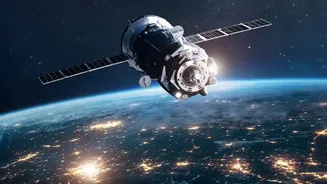
for Earth observation, and reduced launch energy to get there. But this orbital sweet spot has a persistent problem: atmospheric drag. While the air is incredibly thin, it’s not a perfect vacuum. Satellites travelling at over 7 kilometres per second constantly collide with these residual air molecules, causing them to lose speed and altitude. Without a way to counteract this drag, a satellite’s orbit will rapidly decay, and it will fall back to Earth, sometimes within days or weeks.
The Old Solution: A Limited Fuel Tank
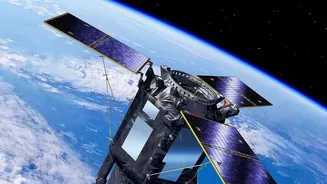
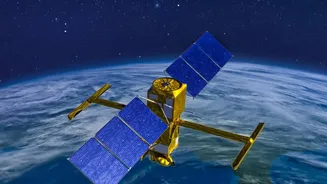
For decades, the standard solution has been to equip satellites with their own propulsion systems and a finite supply of propellant, like xenon gas. These thrusters fire periodically to give the satellite a re-boost, pushing it back up to its desired altitude to compensate for the energy lost to drag. The European Space Agency’s GOCE satellite, for instance, used an electric thruster to operate at a low altitude of 250 km for over four years. However, this approach has a fundamental limitation: the fuel tank. Once the propellant runs out, the mission is over. This onboard fuel also adds significant weight and volume to the satellite, which directly increases launch costs—one of the most expensive parts of any space mission.
A New Idea: The Air-Breathing Engine
What if, instead of fighting the atmosphere, a satellite could use it as a resource? This is the revolutionary concept behind Air-Breathing Electric Propulsion (ABEP), also known as Atmosphere-Breathing Electric Propulsion. It’s a technology that effectively allows a satellite to “breathe” the very air molecules that create drag and use them as a propellant. By scooping up these particles and ejecting them, the system generates thrust. This eliminates the need to carry heavy propellant tanks, promising missions that could last almost indefinitely, limited only by the lifespan of the satellite’s electronic components. The European Space Agency (ESA) successfully tested a prototype in 2018, proving the concept is no longer just a theory.
How This Sci-Fi Tech Works
An ABEP system consists of two main parts: an intake and an electric thruster. The specially designed intake collects the sparse atmospheric molecules—mostly nitrogen and oxygen—as the satellite speeds through its orbit. These collected particles are then funnelled into the thruster, where they are ionised, meaning they are given an electric charge. Finally, an electric field accelerates these newly created ions and expels them at extremely high velocity, producing thrust that counteracts atmospheric drag. The entire system is powered by solar panels, making the atmosphere an effectively limitless source of fuel. This breakthrough is being pursued by various agencies and companies, including ESA, JAXA in Japan, and several startups in the US and India.
The Economic Game-Changer for Constellations
For companies operating large satellite constellations, ABEP technology is a paradigm shift in cost-efficiency. Firstly, by removing the need for heavy propellant tanks, the launch mass of each satellite is significantly reduced. Lighter satellites mean cheaper launches, or the ability to pack more satellites onto a single rocket, drastically cutting deployment costs. Secondly, the mission lifespan is no longer tied to fuel supply. Satellites could operate for a decade or more, dramatically reducing the frequency and cost of replacing them. This extended life and lower mass mean that operators can build more capable constellations in VLEO, offering superior performance for services like high-speed internet and high-resolution imaging at a fraction of the traditional cost.
Challenges and the Path Forward
While the promise of ABEP is immense, several technical hurdles remain. Designing an intake that can efficiently collect enough molecules in the rarefied atmosphere is a major challenge. Furthermore, the thrusters must be able to effectively ionise a mix of atmospheric gases, which is more complex than using a uniform propellant like xenon. The highly corrosive nature of atomic oxygen in VLEO also poses a threat to satellite materials. Despite these challenges, development is advancing rapidly. Research groups and companies like SITAEL, TransMIT, and Phase Four are making progress on thruster efficiency and intake design, with funding from agencies like ESA and DARPA. As these technologies mature, they are paving the way for a new class of sustainable, long-duration missions.