






The Daily Grind of Sitting
Our bodies are designed for movement, but many of us spend upwards of eight hours a day sitting at a desk. This prolonged state of inactivity isn't harmless. When you sit for extended periods, several things happen. Your hip flexor muscles at the front
of your hips remain in a shortened, contracted state, leading to tightness. At the same time, your gluteal muscles (your buttocks) can become underactive or 'switched off'. This imbalance forces other muscles, particularly in your lower back, to compensate and overwork, leading to stiffness and pain. Research links excessive sitting to a host of issues, including poor posture, muscle imbalances, and an increased risk of chronic health problems. Your body essentially adapts to the seated position, which can lead to discomfort when you stand, walk, or exercise.
Your Ally Against Aches: The Foam Roller
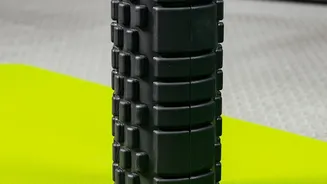
Enter the foam roller, a simple, cylindrical piece of dense foam that can become your best defence against desk-bound discomfort. Foam rolling is a form of self-massage, technically known as self-myofascial release (SMR). Think of it as giving yourself a deep tissue massage to work out the knots and tension that build up in your muscles and the connective tissue surrounding them, called fascia. When muscles are overworked or held in static positions (like when sitting), adhesions or 'knots' can form in this fascia, restricting movement and causing pain. By applying sustained pressure to these spots with a foam roller, you send a signal to your nervous system to relax the muscle, helping to release these adhesions, increase blood flow, and restore the muscle to its proper length and function.
A Simple Routine to Reclaim Your Body
Consistency is key. Performing a short foam rolling routine 3-5 times a week can make a significant difference in how you feel. Focus on the areas most affected by sitting. For each exercise, slowly roll back and forth for about 30 to 60 seconds, and when you find a particularly tender spot, pause on it and take a few deep breaths until you feel the tension start to release. 1. Hip Flexors: Lie face down and place the roller under the front of your left hip. Support your upper body on your forearms. Keep your right leg bent and out to the side for stability. Gently roll up and down the front of your hip. 2. Glutes: Sit on the foam roller with your hands on the floor behind you for support. Cross your right ankle over your left knee and lean your weight onto your right hip, rolling back and forth over the glute muscle. 3. Upper and Mid-Back (Thoracic Spine): Lie on your back with the foam roller placed under your shoulder blades. Bend your knees with your feet flat on the floor and lift your hips. Cross your arms over your chest and slowly roll up and down your mid to upper back. Avoid rolling the lower back directly.
More Key Areas for Relief
Beyond the primary culprits, other muscle groups also suffer from prolonged sitting and can benefit from some attention. 4. Hamstrings: Sit with your legs extended, placing the roller under your hamstrings. Use your hands to support your weight and lift your hips off the floor. Slowly roll from just below your glutes to the back of your knees. For more pressure, cross one leg over the other. 5. Calves: In a similar seated position, move the roller down to your calves. Lift your hips and roll from your ankles to just below your knees. This helps counteract the shortening that can occur when your feet aren't flat on the floor for long periods. 6. Pecs (Chest Muscles): To combat the forward slump of the shoulders, lie face down and place the roller under the front of your shoulder, near your armpit, at a slight angle. Gently roll back and forth over the chest muscle to help open up your posture.
Tips for Safe and Effective Rolling
To get the most out of your foam rolling practice, keep a few things in mind. Always move slowly and with control; speed is not the goal. Remember to breathe deeply throughout each movement, which helps your muscles relax. Apply firm but not excruciating pressure—you should feel discomfort, but not sharp pain. If you're a beginner, start with a lower-density, softer foam roller. It's important to avoid rolling directly over joints like your knees or elbows, as well as the sensitive area of your lower back, which lacks the structural support of the rib cage. The goal is to massage muscle tissue, not bone or joints.