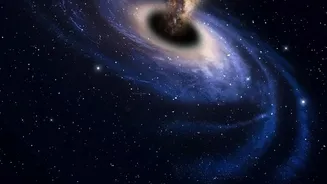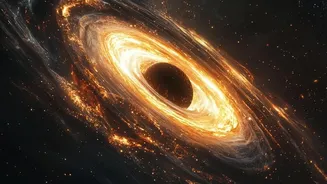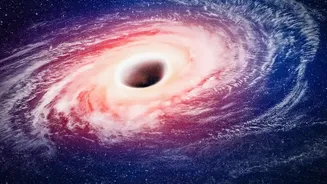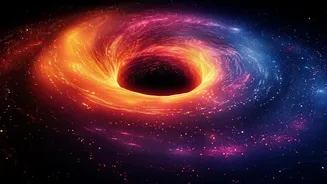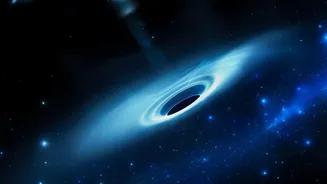



When we think of black holes, we picture cosmic monsters, billions of times heavier than our Sun, swallowing everything in sight. But what if there’s another kind—ancient, tiny, and born from the Big Bang itself? Let's explore this possibility.
The Black Holes We Already Know
In the
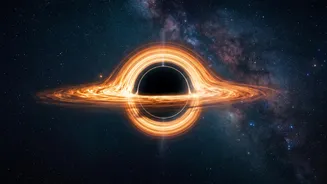
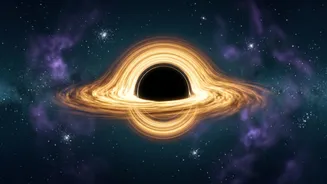
cosmic zoo, astronomers have generally identified two main types of black holes. The first are stellar-mass black holes, which are typically a few to a few dozen times the mass of our Sun. These form when a single, massive star runs out of fuel and collapses under its own gravity. The second type are the supermassive black holes, the behemoths that lurk at the centres of most galaxies, including our own Milky Way. These can have masses millions or even billions of times that of the Sun. While their exact formation is still debated, they are a fundamental part of galactic evolution. But what if this binary classification is incomplete? Some scientists have long theorised about a third, more elusive category.
A Different Breed: Primordial Black Holes
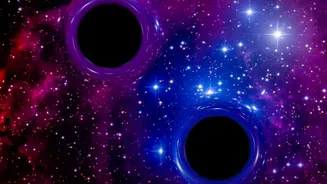
This third type are known as Primordial Black Holes, or PBHs. Unlike their stellar counterparts, they didn't form from dying stars. Instead, the theory, first proposed by Stephen Hawking and others, suggests they were born within the first second after the Big Bang. In that incredibly chaotic and dense early universe, long before stars or galaxies existed, some regions might have become so incredibly dense that they collapsed directly into black holes. This formation mechanism means they are not bound by the same size constraints as stellar-mass black holes, which require a star of at least eight times the Sun's mass to form.
Just How Small Are We Talking?
The term 'smaller' can be an understatement. Depending on the exact moment they formed in that first chaotic second, primordial black holes could span a vast range of masses. Some could be as massive as several thousand suns, but many could be much, much smaller. Theories predict PBHs with the mass of a planet, an asteroid, or even less. A primordial black hole with the mass of Earth, for instance, would have an event horizon—the point of no return—of only a couple of centimetres across. In a famous calculation, Stephen Hawking determined that any PBH with a mass less than a large mountain would have already evaporated by now due to a process known as Hawking radiation. But those with masses greater than that could still be drifting through the cosmos today.
The Hunt for Invisible Clues
If these PBHs exist, why haven't we found one? The answer is simple: they are incredibly difficult to detect. A small, isolated black hole that isn't pulling in material from a companion star would be almost completely invisible. So, scientists have to get creative. One key method is searching for gravitational lensing events. If a PBH passes in front of a distant star, its gravity would bend the starlight, causing the star to briefly appear brighter. Observing such 'microlensing' events could be evidence of these invisible objects. Other potential signals could come from the gravitational waves emitted when PBHs collide or from gamma rays produced by the final moments of the smallest evaporating black holes.
A Potential Solution to a Huge Mystery
The search for PBHs is not just a cosmic treasure hunt; it's linked to one of the biggest unsolved problems in physics: dark matter. Scientists know that about 27% of the universe is made of this mysterious, invisible substance, but they don't know what it is. Primordial black holes are a compelling candidate. They are non-baryonic (not made of protons and neutrons), stable, and would have formed early enough to shape the galaxies we see today. If dark matter is indeed composed of a vast population of ancient, small black holes, it would elegantly solve a major puzzle without needing to invent new, undiscovered particles. This possibility is a powerful motivation for astronomers to keep searching.