




The Heart of Colonial Calcutta
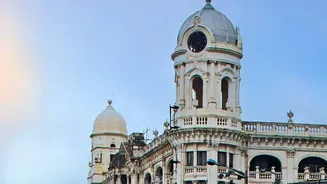
Our walk begins in B.B.D. Bagh, the former Dalhousie Square, which remains the city's commercial and administrative hub. This area was the nucleus of British power, planned around a large water tank, Lal Dighi, which reflects the grand buildings that
surround it. Once named for Lord Dalhousie, a Governor-General of India, the square was renamed Benoy-Badal-Dinesh Bagh to honour three freedom fighters who, in 1930, made a daring attack inside the Writers' Building. Today, the square is a living museum, buzzing with office-goers and history buffs, where grand colonial architecture stands as a testament to Calcutta's formidable past as the second city of the British Empire.
The Iconic Writers' Building
Dominating the northern side of the square is the Writers' Building, or Mahakaran. With its striking red facade and Greco-Roman architectural style, it's impossible to miss. Designed by Thomas Lyon in 1777, it was originally built to house the junior clerks, or 'writers', of the East India Company. Over the years, it was expanded and transformed from a functional office into a grand secretariat for the Government of West Bengal. Statues representing concepts like Justice, Commerce, Science, and Agriculture line the terrace, crowned by a sculpture of the Roman goddess Minerva. The building is a powerful symbol of both colonial authority and India's struggle for freedom.
The Grand General Post Office (GPO)
A short walk from the Writers' Building leads to the magnificent General Post Office. Completed in 1868 and designed by Walter B. Grenville, this structure is a marvel of colonial architecture, noted for its high domed roof and towering Ionic-Corinthian pillars. Functioning as the central post office for the city, it stands on the historic site of the first Fort William, which was attacked during the Siege of Calcutta in 1756. A brass plate on an eastern staircase is said to mark the boundary of the old fort. Inside, a postal museum showcases a collection of rare stamps and artefacts, offering a glimpse into India's long postal history.
An Oasis of Calm: St. John's Church
Nearby, St. John's Church offers a tranquil escape. Founded in 1784, it was one of the first public buildings erected by the East India Company after Calcutta became the effective capital. For a time, it served as the city's main Anglican cathedral. Often called 'Pathure Girja' or the Stone Church, it was built with a combination of brick and stone, a rare material in 18th-century Calcutta that was transported from the medieval ruins of Gour. The churchyard itself is historic, containing the mausoleum of Job Charnock, traditionally regarded as the founder of Kolkata. Its neoclassical design, modeled after St Martin-in-the-Fields in London, and the tall stone spire make it a serene and significant landmark.
The Reborn Currency Building
Our final stop is the Currency Building, an impressive Italianate structure from 1833. Originally the Agra Bank, it was later converted into the office for government currency and even briefly housed the Reserve Bank of India. With its arched roof, Venetian windows, and marble floors, the building was a hub of financial activity. After falling into disrepair, it was slated for demolition in the 1990s but was saved by timely intervention. Today, the beautifully restored building has been reborn as 'Ghare Baire', a museum and art gallery showcasing centuries of art from Bengal, giving this historic structure a vibrant new purpose.