

First, What Is a 'Secure Quantum Link'?
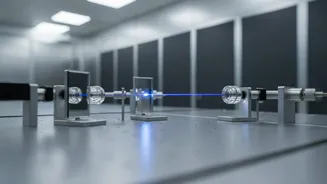
Imagine trying to send a secret message by writing it on a soap bubble. The moment anyone tries to intercept and read it, the bubble pops, and you instantly know someone was listening. That, in a nutshell, is the principle behind Quantum Key Distribution
(QKD). Instead of soap bubbles, QKD uses individual particles of light, called photons. These photons are sent with specific quantum properties, like their polarization. According to the fundamental laws of physics, the very act of observing an unknown quantum state changes it. So, if an eavesdropper tries to intercept the photons to read the key, they will inevitably alter them, creating detectable errors and alerting the intended recipients. This method doesn't rely on complex math problems that a future supercomputer might solve; it relies on physics. The result is a way to create and share an encryption key that is, in theory, unhackable.
The Vulnerability of Modern Satellites
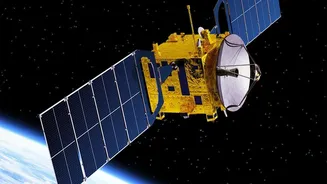
From GPS navigation and financial transactions to military intelligence and disaster management, modern life runs on satellites. These orbiting data hubs are critical national infrastructure. The problem is that the signals they send back and forth can be intercepted. While these signals are heavily encrypted, they are vulnerable to a 'harvest now, decrypt later' attack. An adversary could record massive amounts of encrypted data today and simply wait for the day a powerful enough quantum computer exists to break the current encryption standards. For a nation's military secrets or long-term economic strategies, that’s an existential threat. Securing these space-based communication channels isn't just an upgrade; it's a necessity for future national security.
India's Leap into the Quantum Space Race
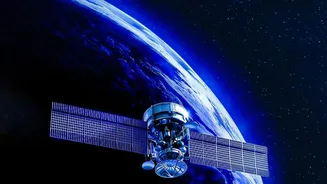
While China grabbed headlines by launching the world's first quantum satellite, 'Micius,' back in 2016 and using it for intercontinental quantum-secured video calls, it is no longer the only player. India has made its own quiet but significant strides. The Indian Space Research Organisation (ISRO), in collaboration with research institutes, is actively working on satellite-based quantum communication. In 2021, ISRO successfully demonstrated free-space QKD over a distance of 300 meters, a crucial first step. This test included quantum-key-encrypted videoconferencing, proving the concept on the ground. These efforts are part of India's broader National Quantum Mission, a major government initiative launched in 2023 with a budget of over $700 million to build domestic capabilities in all areas of quantum technology. The stated goal includes developing satellite-based secure quantum communication between ground stations across India, spanning distances of up to 2,000 kilometers.
Why This Matters for the U.S. and the World
India's push into quantum satellite links is more than a scientific achievement; it's a geopolitical statement. In an era increasingly defined by strategic competition between the U.S. and China, the development of a third, independent pole in a critical technology like quantum communication is significant. For the United States, India's progress represents the rise of a key democratic partner with sophisticated technological capabilities. This could lead to future collaborations on securing space assets and creating a global communication network that isn't solely reliant on Chinese or American technology. As more of the world's critical infrastructure becomes dependent on space-based assets, the ability to secure those assets becomes a measure of power. By developing its own sovereign, hack-proof communication technology, India is ensuring its strategic autonomy in the 21st century and positioning itself as a crucial player in the new, high-tech global order.