





Artemis: The Return to the Moon
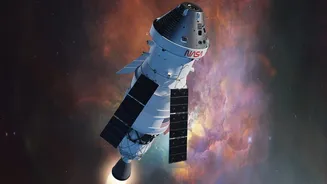
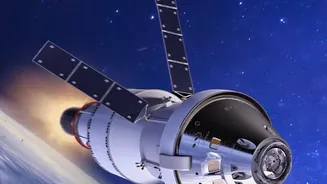
More than half a century after the last Apollo mission, humanity is going back to the Moon, and this time, the goal is to stay. The Artemis program is NASA's ambitious plan to establish a sustainable human presence on the lunar surface. After the successful
uncrewed Artemis I test flight and the crewed Artemis II fly-by, all eyes are on future missions like Artemis III and IV, which aim to land astronauts, including the first woman, on the lunar south pole. The ultimate goal is to build a long-term base camp. But Artemis is about more than just lunar footprints. The Moon is being treated as a crucial stepping stone for the next giant leap: Mars. Technologies for life support, resource utilisation (like mining water ice for rocket fuel), and long-duration space travel will all be tested and perfected in the relative safety of the lunar environment before we commit to the years-long journey to the Red Planet.
Perseverance: Searching for Ancient Life on Mars
While Artemis prepares for future human visitors, the Perseverance rover is currently on Mars, acting as a robotic geologist and astrobiologist. Landing in the Jezero Crater in 2021, an area believed to be an ancient lakebed, its primary mission is to search for signs of past microbial life, or biosignatures, preserved in the rock. This is a fundamental question for humanity: are we alone? Perseverance is equipped with sophisticated instruments to analyse rock chemistry, but its most important task is collecting and storing promising rock and soil samples. In a complex, multi-stage mission planned for the future, these samples will be retrieved and brought back to Earth for analysis in advanced laboratories. This Mars Sample Return campaign would be a landmark achievement, potentially providing definitive proof of whether life has ever existed on another planet.
James Webb Space Telescope: A Window to the Beginning of Time
Arguably the most powerful observatory ever built, the James Webb Space Telescope (JWST) is not exploring a single destination, but the entire history of the universe. Positioned a million and a half kilometres from Earth, its giant, gold-coated mirror is designed to capture faint infrared light that has travelled for billions of years. Since beginning operations, JWST has delivered breathtaking images and revolutionary science. It has peered into the atmospheres of distant exoplanets, detecting key molecules like carbon dioxide, a crucial step in assessing their potential habitability. Most profoundly, it has discovered galaxies that are far more massive and complex than theories predicted for the early universe, forcing scientists to rethink how quickly the first stars and galaxies formed after the Big Bang. Each discovery from Webb refines our understanding of cosmic origins and our own place within this vast, evolving story.
Europa Clipper: Exploring an Ocean World
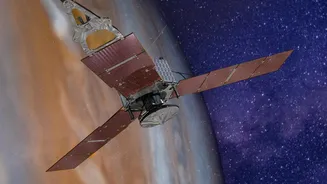
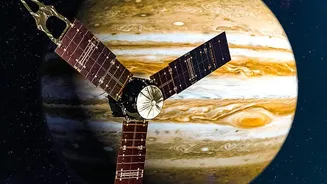
The search for life isn't limited to Mars. Launched in late 2024, the Europa Clipper spacecraft is on a multi-billion-kilometre journey to Jupiter's moon, Europa. Scientists have strong evidence that beneath Europa's thick ice shell lies a global saltwater ocean that may contain more than twice the water of all of Earth's oceans combined. Europa Clipper is not designed to find life directly, but to determine if this hidden ocean has the right conditions to support it. Arriving at Jupiter in 2030, the spacecraft will perform dozens of close flybys, using a suite of instruments to measure the ice shell's thickness, scan for plumes of water vapour erupting into space, and analyse the moon's surface chemistry. Its findings will be critical for planning future missions that could one day land on the ice and perhaps even send a probe into the mysterious ocean below, one of the most promising places to look for life in our solar system.