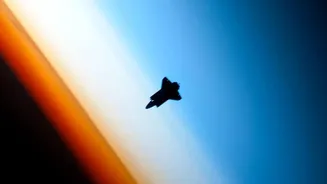







The Philosophical Benchmark: 2001: A Space Odyssey (1968)
You can't discuss cinematic space without starting with Stanley Kubrick’s masterpiece. Decades before digital effects became standard, '2001' created a vision of space travel that still feels breathtakingly real. Kubrick and his special effects team,
including the legendary Douglas Trumbull, pioneered techniques that set a new standard for realism. They famously avoided common shortcuts like blue screen, instead using painstaking methods like 'front projection' to seamlessly blend actors with vast, pre-filmed backgrounds. The result was a crisp, clear image that convinced audiences they were truly floating in zero gravity or striding across the moon. The film’s iconic 'Star Gate' sequence, a psychedelic trip through space and time created with a novel technique called 'slit-scan' photography, remains one of cinema’s most audacious and influential visual accomplishments. '2001' is more than a movie; it’s a meditative, visual poem that proved science fiction could be high art.
The Immersive Thrill Ride: Gravity (2013)
While Kubrick aimed for philosophical grandeur, Alfonso Cuarón’s 'Gravity' focused on the visceral, terrifying reality of being stranded in orbit. The film’s brilliance lies in its ability to make the audience feel every heart-pounding moment alongside Sandra Bullock’s Dr. Ryan Stone. Using a seamless blend of live-action and groundbreaking CGI, Cuarón and cinematographer Emmanuel Lubezki created long, uninterrupted shots that convey the dizzying weightlessness and profound isolation of space. The filmmakers invented new technology, including a 'Light Box' cube of LED panels, to simulate the harsh, ever-changing light of Earth’s orbit on the actors' faces. The camera moves as if it, too, is a character, spinning and tumbling through debris fields in a way that is both terrifying and balletic. 'Gravity' isn't just a story set in space; it’s an experience that puts you inside the helmet, fighting for every breath.
The Grounded Spectacle: Interstellar (2014)
Christopher Nolan is famous for his dedication to practical effects, and 'Interstellar' is his grandest showcase. To bring his deep-space odyssey to life, Nolan’s team built full-scale spaceship interiors and used intricate miniatures for exterior shots, lending a tangible weight and realism to the spacecraft. But the film’s most celebrated achievement is its scientifically accurate visualisation of a wormhole and the supermassive black hole, Gargantua. Working closely with theoretical physicist Kip Thorne, the visual effects team at Double Negative developed new CGI software that could render these cosmic phenomena based on real scientific equations. The result was a set of images so groundbreaking they led to new scientific insights. From towering tidal waves on a distant world to the dizzying journey through a tesseract, 'Interstellar' marries hard science with stunning spectacle, creating a truly epic sense of discovery.
The Atmospheric Masterwork: Blade Runner 2049 (2017)
While only partially set in off-world colonies, the aesthetic of Denis Villeneuve's 'Blade Runner 2049' is a masterclass in sci-fi world-building. Cinematographer Roger Deakins, who won his first Oscar for his work here, crafted a series of unforgettable, painterly images. Each frame is drenched in atmosphere, from the smog-choked, neon-drenched streets of Los Angeles to the eerie, orange haze of a post-apocalyptic Las Vegas. Deakins is a master of light, using constantly moving and shifting sources to create environments that feel alive and deeply textured. He worked with Villeneuve to create a palette that told a story, using stark silhouettes, geometric framing, and bold washes of colour to evoke emotion and define the film's desolate but beautiful world. 'Blade Runner 2049' proves that sci-fi visuals can be as much about mood and artistry as they are about explosive action.