



A New Geometric Wonder
For decades, scientists have been captivated by a massive, six-sided jet stream at Saturn's north pole, famously known as the hexagon. It’s a remarkably stable feature, observed for over 40 years since the Voyager probes first flew by. Now, the planet's
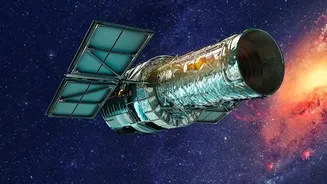
southern hemisphere is presenting its own geometric curiosity. Recent observations from the Hubble Space Telescope have revealed a giant, 10-sided atmospheric wave, or decagon, encircling the south pole. This is the first time such a large, regular-sided pattern has been seen in the planet's southern hemisphere, giving scientists a rare chance to watch a massive weather system take shape in real-time.
What Makes This Wave So Unusual?
Unlike the long-lived northern hexagon, this southern decagon is a newcomer. Analysis of archival data from Hubble's Outer Planet Atmospheres Legacy (OPAL) program shows that hints of the structure only began to emerge around 2023, with the pattern becoming more defined through 2024 and 2025. This recent and rapid formation is what has scientists particularly intrigued. The northern hexagon is a fixture, but this southern feature appears to be actively evolving and strengthening. Furthermore, the wave isn't just a surface-level phenomenon. It extends deep into multiple layers of Saturn's atmosphere, indicating it's a significant, vertically-structured disturbance within one of the planet's powerful jet streams.
The Hunt for an Explanation
So, why did this decagon suddenly appear? Scientists don't have a definitive answer yet, but they have several working theories. The discovery was made possible as Saturn's 29-year orbit around the sun tilted its south pole back into Earth's view. This allowed astronomers, including amateurs, to spot early signs of the wavy band. One idea is that the wave is a type of planetary phenomenon known as a Rossby wave, where rotating fluids and variations in latitude can force high-speed winds into stable, geometric shapes. Another possibility is that a large storm, like an anticyclonic vortex, may have disturbed the jet stream and triggered the wave's formation. Researchers had been searching for a southern counterpart to the northern hexagon since the 1990s, but even NASA's Cassini spacecraft, which orbited Saturn from 2004 to 2017, saw no signs of it.
Hubble's Enduring Gaze
This discovery highlights the incredible value of long-term observation programs like Hubble's OPAL. By imaging the outer planets annually for over a decade, Hubble provides a unique ability to track gradual changes and detect slowly developing features that single missions might miss. While ground-based telescopes first flagged the anomaly, Hubble's sharp vision from above Earth's blurring atmosphere was crucial for confirming the 10-sided shape and its characteristics. The long operational life of the telescope allows astronomers to move beyond single snapshots and instead create a timeline of planetary evolution, revealing surprising events like the birth of this new decagon.
Why Saturn's Weather Matters
Studying the atmospheres of gas giants like Saturn helps us understand the fundamental physics that governs weather on all planets, including our own. These distant worlds are natural laboratories for atmospheric dynamics on a scale impossible to replicate on Earth. By observing how these giant geometric patterns form, evolve, and either persist or dissipate, scientists can refine their models of planetary atmospheres. The mystery of the southern decagon—whether it will become a permanent fixture like its northern sibling or fade away—remains to be seen. Future observations from Hubble and the James Webb Space Telescope will be key to unlocking the secrets of this strange and beautiful new feature on our magnificent ringed neighbour.