



The Universe’s Ultimate Group Chat
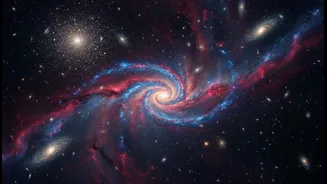
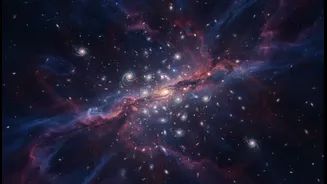
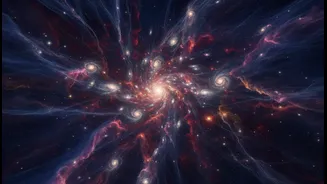
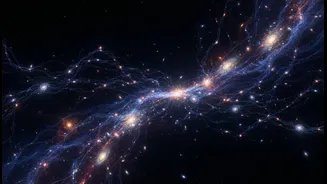
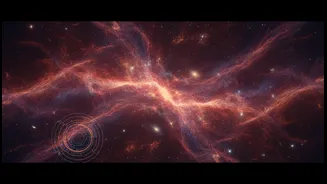
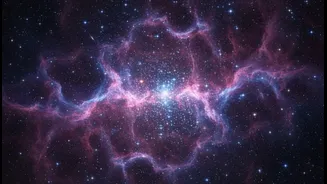
First, let's set up the chat itself. On the grandest scale, the universe isn’t a random spray of galaxies. It’s an intricate, beautiful network known as the cosmic web. Think of it as a vast, dark scaffolding made of invisible dark matter, stretching
across billions of light-years. This framework is composed of immense filaments and sheets, surrounding enormous, nearly empty voids. At the intersections of these filaments, where matter is densest, gravity pulls in gas to form the galaxies, stars, and planets we can see. For a long time, our understanding of this process—cosmic structure formation—was based on this simple, gravity-driven model dominated by dark matter.
Someone Turned Up the Resolution
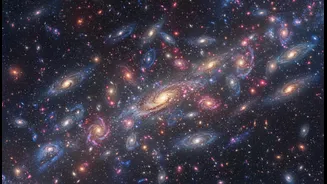
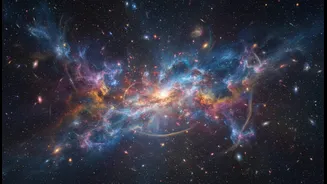
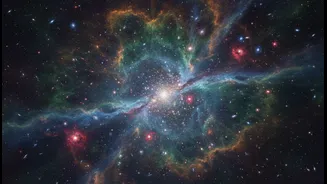
Recently, the James Webb Space Telescope (JWST) dropped the clearest picture of this chat ever seen. Its largest survey to date, called COSMOS-Web, has mapped this structure in unprecedented detail, peering back to when the universe was less than a billion years old. Where previous maps were blurry and sparse, JWST provides a view with a jump in depth and resolution so significant that what once looked like a single, blurry structure now resolves into many distinct filaments and galaxies. This new map is so precise it allows astronomers to trace the growth of galaxies within the cosmic web across almost all of cosmic history, revealing how this framework shapes their evolution.
A Digital Twin of the Cosmos Logs On
At the same time, a new user joined the chat: the FLAMINGO simulations. These aren't just any computer models; they are among the largest and most sophisticated virtual universes ever created. Run on a supercomputer for over 50 million processor hours, they simulate the evolution of everything from just after the Big Bang to today. What sets FLAMINGO apart is that it doesn't just model the simple gravity of dark matter. It includes the messy, complex physics of ordinary matter—the stuff that makes up stars, gas, and us—as well as the subtle effects of tiny particles called neutrinos.
Reading the New Chat Logs
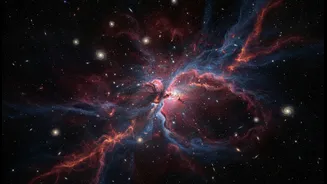
Here’s why this is a game-changer. For years, there has been a growing tension between what our simpler simulations predicted and what our telescopes were seeing. The FLAMINGO simulations, by including the complex effects of ordinary matter like galactic winds from exploding stars and jets from supermassive black holes, are helping to bridge that gap. Scientists can now create virtual universes that look remarkably like the real one being observed by JWST. These new models show that the contribution of ordinary matter can no longer be ignored; its effects are crucial for understanding how the cosmic web truly formed and grew. This powerful combination of ultra-detailed observations and ultra-realistic simulations is the new conversation in cosmology.