




Seeing the Unseen
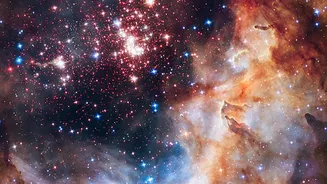
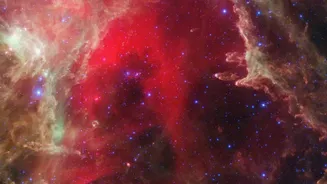
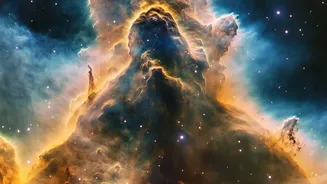
Imagine trying to watch a play from behind a thick, dusty curtain. That’s the challenge astronomers faced for decades when studying stellar nurseries. These vast clouds of gas and dust, where stars are born, are so dense that they block visible light
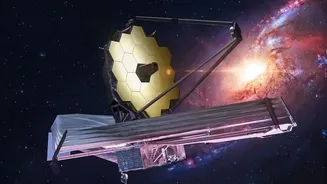
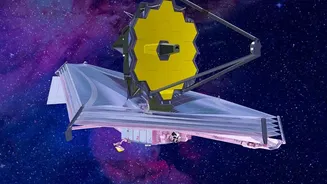
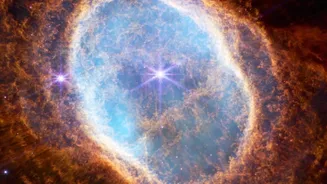
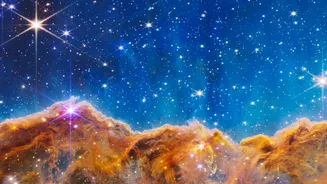
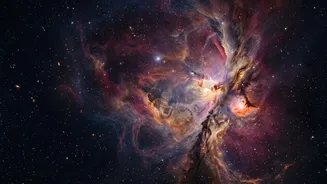
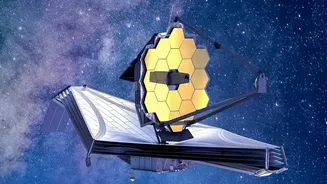
entirely. To telescopes like Hubble, these regions appeared as dark, empty patches in the sky. But where Hubble saw darkness, the James Webb Space Telescope sees a vibrant, chaotic nursery teeming with activity. The key is infrared light. Infrared wavelengths are longer than visible light, allowing them to slip through the dense clouds of dust that would otherwise obscure our view. This capability allows JWST to peer directly into the heart of these stellar nurseries and witness the very first stages of a star’s life.
Anatomy of a Protostar
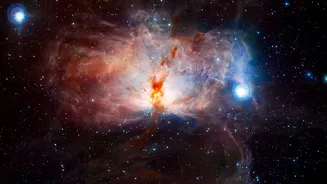
JWST’s images have provided unprecedented detail about protostars, the infant bodies that have not yet become true stars. In a star-forming region called L1527, Webb captured a stunning image of a protostar cocooned within a dark cloud. What looks like a fiery hourglass is actually a cavity being carved out by material ejected from the central star. The protostar itself is hidden within the narrow “neck” of this hourglass, where a rotating disk of gas and dust, known as a protoplanetary disk, is feeding it material. This disk is where future planets will eventually form. These protostars are incredibly young, some only about 100,000 years old, and are not yet generating their own energy through nuclear fusion like our Sun. They are hot, puffy clumps of gas, slowly gathering mass on their long journey to becoming fully-fledged stars.
Cosmic Jets and Shockwaves
The process of star birth is far from gentle. As a protostar pulls in gas and dust from its surrounding disk, it also violently ejects material in powerful jets that shoot out from its poles. Webb's high-resolution infrared cameras can see these jets and the shockwaves they create as they slam into the surrounding molecular cloud. In regions like Herbig-Haro 797, these outflows create luminous, intricate patterns as they collide with nearby gas and dust at high speeds. Scientists can study the shape and composition of these outflows to understand the history of the star's activity, almost like reading the rings of a tree. These dramatic ejections also play a crucial role in regulating star formation, as the turbulence they create can prevent other stars from forming too close by, allowing the protostar to dominate its local environment.
From Icy Grains to New Worlds
Beyond just the mechanics of star birth, JWST is revealing the chemical ingredients available for building new solar systems. Its instruments can detect the composition of the dust and gas in these regions, identifying crucial molecules like water ice and complex organics within the clouds where stars gather mass. By observing these protoplanetary disks, astronomers can watch as water transitions from ice to vapor as it gets closer to the warming protostar, creating a rich environment where rocky, Earth-like planets might one day take shape. This offers a profound glimpse into the conditions that may have existed when our own solar system was forming some 4.6 billion years ago, connecting these distant cosmic nurseries directly to our own origins.