







What Exactly Is an Optical Skyrmion?
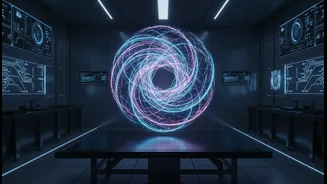
First conceptualized in nuclear physics, a skyrmion is a stable, particle-like anomaly in a field. Imagine a smoothly combed field of arrows all pointing up; a skyrmion is like a tiny, robust whorl where the arrows artfully twist to point in all directions
before returning to uniformity at the edges. For decades, these were studied in magnetic materials, where they are formed by the spins of electrons. Optical skyrmions are the next evolution of this idea, where the 'field' is not magnetism but light itself. They are nanoscale knots or swirling textures in a light field's properties, such as its polarization or electric field. The key feature is their stability, a property known as topological protection. This means they don't easily unravel or fall apart, making them remarkably robust information carriers.
The Promise: A Leap for Computing and Data
The primary excitement around optical skyrmions stems from their potential to revolutionize how we handle data. Their small size and stability make them ideal candidates for next-generation, high-density data storage. Information could be encoded in the presence, absence, or specific type of a skyrmion, allowing us to pack more data into smaller spaces. Because they are made of light, they can be manipulated and moved at incredible speeds, promising optical processing and logic devices that are far faster and more energy-efficient than current electronics. This opens the door to all-optical computing, where information is processed without ever needing to be converted into slower electrical signals.
Beyond Data Storage: Other Potential Gains
The applications for these light-based quasiparticles extend beyond just computing. Their unique structures are being explored for high-resolution imaging and metrology. Because the structure of a skyrmion is not limited by the diffraction of light, they could be used to create microscopes capable of seeing details at a scale far smaller than what is possible today. Researchers are also investigating their role in quantum technologies. The inherent stability that makes them great for data storage also makes them promising candidates for qubits in quantum computers, which are notoriously fragile and susceptible to disturbance from their environment.
The Reality Check: What Still Needs Checking
Despite the immense potential, optical skyrmions are still a nascent field of research, and significant hurdles remain. One of the biggest challenges has been the difficulty and expense of creating them. Traditionally, generating optical skyrmions required complex, man-made metamaterials or highly specialized lab setups. Furthermore, controlling and manipulating these light structures with precision, especially at room temperature, is a major engineering problem that needs to be solved before practical applications can be realized. There is also a lot of fundamental physics left to understand. Researchers are still exploring the full 'zoo' of possible skyrmion-like structures and how they interact with each other and with matter.
The Path Forward for Researchers
The scientific community is actively working to overcome these challenges. Recently, a major breakthrough was announced by researchers at Nanyang Technological University in Singapore, who discovered a much simpler way to create optical skyrmions. By shining a laser onto a small disc—a technique based on a 200-year-old optical phenomenon known as the Poisson spot—they were able to generate multiple types of skyrmions at once without expensive equipment. This development significantly lowers the barrier for other scientists to create and study these structures, which should accelerate research. The next steps involve moving from fundamental discovery to applied engineering: developing effective ways to detect these topologies and integrate them into practical devices for communication, sensing, and computing.