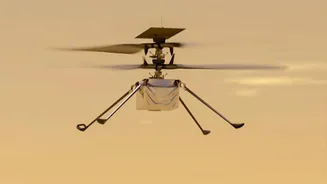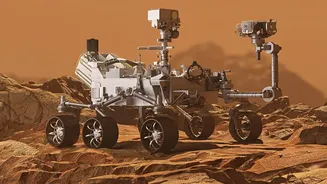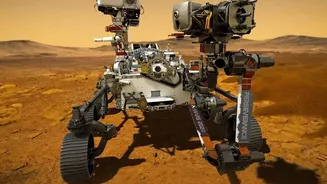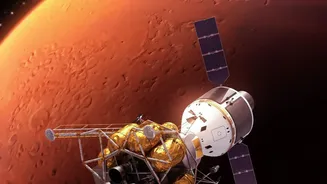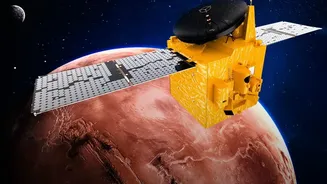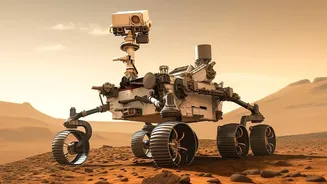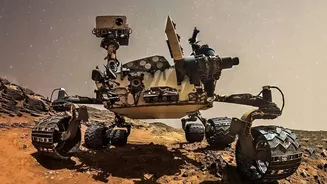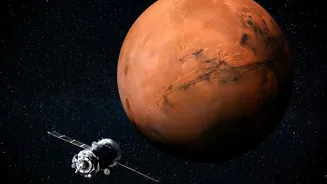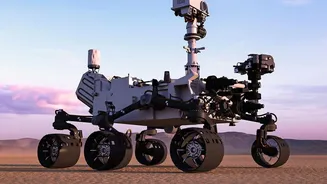




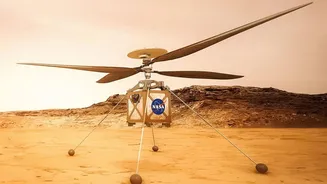
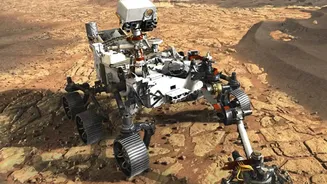
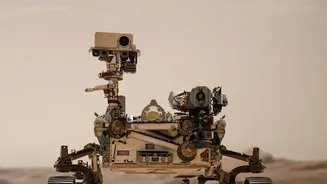
For years, the Perseverance rover has been drilling and storing priceless rock samples on Mars. Now, the monumental challenge is getting them home, and NASA is kickstarting a fresh push to make this unprecedented interplanetary retrieval a reality.
A Rover's Treasure Trove
Since
its dramatic landing in February 2021, NASA's Perseverance rover has been dutifully exploring Mars' Jezero Crater, an ancient lakebed that may hold clues to the planet's past. Its primary mission has not just been to study the environment, but to act as a planetary geologist, collecting a cache of scientifically-selected rock and soil samples. As of 2025, the rover had already collected over two dozen core samples, storing them in sealed, cigar-sized titanium tubes. Some of these tubes are held aboard the rover, while a backup depot of ten tubes has been strategically placed on the Martian surface at a site named 'Three Forks', waiting for a future pickup. These samples are considered a scientific treasure, potentially holding the key to answering one of humanity's biggest questions: did life ever exist on Mars?
A Mission in Flux
The original Mars Sample Return (MSR) campaign, a joint effort with the European Space Agency (ESA), was an ambitious, multi-part plan. It involved a lander touching down, a small rocket (the Mars Ascent Vehicle) launching the samples into orbit, and an orbiter catching the container for the long journey back to Earth. However, the complexity and cost of this historic undertaking led to a rethink. Independent reviews highlighted ballooning budgets, with one estimate reaching as high as $11 billion and a return date pushed to 2040, a timeline and price tag NASA deemed unacceptable. In early November 2026, NASA announced it was charting a new course, initiating the 'Perseverance Sample Retrieval Architecture' (PSRA) to find a more feasible and timely way to bring the precious cargo home.
Why These Rocks Are Worth It
While Perseverance is equipped with impressive onboard instruments, the most sophisticated laboratories are here on Earth. Bringing samples back would allow scientists from around the world to analyze them with state-of-the-art equipment that is too large and power-hungry to send to Mars. This would enable a level of analysis and reproducibility that's impossible to achieve remotely. Scientists could definitively determine the age and composition of the rocks, reconstruct Mars' geological and climate history, and search for indisputable biosignatures, or signs of past microbial life. Furthermore, the samples could be preserved for future generations, who could re-analyze them with technologies that haven't even been invented yet, similar to how Apollo Moon rocks are still yielding new discoveries today.
The Challenge of an Interplanetary Delivery
Retrieving samples from Mars is a monumental engineering feat, far more complex than returning material from the Moon or an asteroid. The mission requires landing a spacecraft with precision, deploying a system to collect the sample tubes, and then successfully launching the first-ever rocket from the surface of another planet. Each step is fraught with risk, from navigating Mars' thin but tricky atmosphere to the autonomous coordination required between multiple robotic systems millions of miles from home. There are also immense planetary protection concerns, requiring the samples to be securely contained to prevent any potential contamination of Earth's biosphere, however unlikely. This new PSRA initiative, which will kick off in January 2027, will re-evaluate all these challenges to forge a new path forward.
A New Space Race?
The push to restructure the Mars Sample Return mission comes with an added sense of urgency. China is making significant progress on its own sample return mission, Tianwen-3. Current plans show China aiming for a 2028 launch, with the goal of returning about 500 grams of Martian material to Earth as early as 2031. This has injected a competitive element into the scientific endeavor, with some observers calling it a potential 'Sputnik moment'. As NASA goes back to the drawing board, the timeline remains a key question. While the previous plan faced delays, the new strategy aims to find a faster and more affordable architecture, with a final report from the PSRA team expected in the winter of 2027-2028.