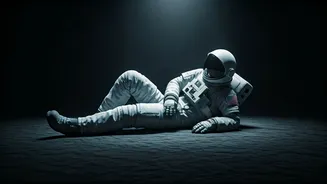









An Unforgiving Environment
On Earth, our atmosphere acts like a giant, protective filter. It scatters and absorbs a significant portion of the sun's energy. In the vacuum of space, there is no such filter. An astronaut in low Earth orbit is exposed to the full, brutal, unfiltered
force of solar radiation. When the sun is shining, the side of the spacesuit facing it can heat up to a scorching 250 degrees Fahrenheit (about 121 degrees Celsius). Without protection, this would be instantly fatal. The engineering challenge is immense: how do you build a wearable vehicle that can shield a human from temperatures that would boil water?
The Simplest, Smartest Solution
The answer starts with a principle you learned in grade-school science: dark colors absorb light (and heat), while light colors reflect it. White is the most reflective color, bouncing away the most energy across the visible spectrum and beyond. By making the outer layer of a spacesuit white, engineers employ a remarkably simple, passive cooling system. The suit’s outer layer, officially known as the Thermal Micrometeoroid Garment (TMG), reflects the vast majority of the sun's radiation, preventing the suit and the astronaut inside from cooking. It’s a low-tech, highly effective solution to a high-tech problem, akin to choosing a white t-shirt over a black one on a blazing summer day, but with life-or-death stakes.
But What About the Cold?
Here’s where it gets more complicated. While the sun-facing side of a suit is roasting, the side in shadow is experiencing the opposite extreme. With no atmosphere to hold onto heat, temperatures in the shade can plummet to a bone-chilling -250 degrees Fahrenheit (-157 degrees Celsius). A spacesuit can’t just be a reflector; it also has to be an incredible insulator. This is why a spacesuit is not a single garment but a multi-layered system. The suit, more accurately called an Extravehicular Mobility Unit (EMU), is essentially a personalized spacecraft. It’s a pressurized, self-contained environment designed to manage this wild temperature swing. The same outer layers that reflect heat also help insulate the astronaut from the deep cold, trapping their body heat inside.
A Suit of Many Layers
Beneath the white outer shell lies a marvel of engineering. An astronaut first puts on a Liquid Cooling and Ventilation Garment, which looks like a set of long underwear threaded with over 300 feet of thin tubing. Water flows through these tubes to pull excess heat away from the astronaut’s body. Above that is a pressure bladder, an inflatable layer that maintains the correct atmospheric pressure to keep an astronaut's bodily fluids from boiling in the vacuum. Then come the structural and restraining layers. Finally, the tough, 14-layer TMG provides the thermal protection and shields against tiny, high-velocity space debris—micrometeoroids—that could otherwise puncture the suit. The white fabric you see is just the final, outermost part of this complex, life-sustaining cocoon.
So Why Are Some Suits Orange?
If white is so important, why are the famous NASA “pumpkin suits” a vibrant orange? This highlights the most important rule of engineering: form follows function. The white EMU is designed for extravehicular activity—spacewalking. Its main job is thermal management in the vacuum. The orange suits, known as the Advanced Crew Escape Suit (ACES) and its modern successor for the Orion capsule, are designed for launch and re-entry. Their job isn’t to survive in space for hours, but to keep the crew alive during the most dynamic phases of flight and in the event of an emergency. In that context, the number one priority is visibility. Bright orange is the most visible color to rescue teams, especially against the blue of an open ocean. Different missions, different priorities, different suits.