





Beyond the Goggles
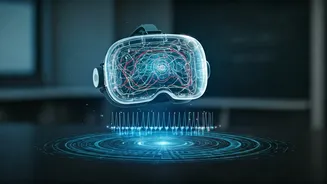
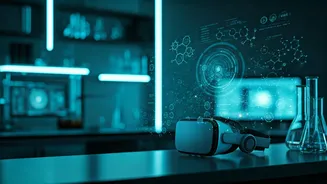
When we think of VR, our minds often jump to gaming. But one of its most transformative applications is unfolding in the world of science and education. A virtual science lab is far more than just a 3D video. Using a VR headset and controllers, a student
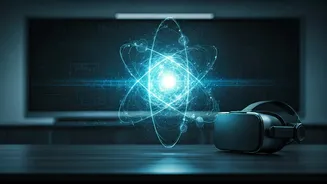
is transported into a fully interactive, three-dimensional laboratory. They can see, move around, and interact with the environment just as they would in the real world. They can pick up beakers, operate a centrifuge, or titrate chemicals. The goal is to create a sense of 'presence'—the feeling of actually being there—which is crucial for effective hands-on learning. High-fidelity graphics and realistic physics engines simulate everything from the viscosity of a liquid to the heat generated in a chemical reaction, making the experience deeply educational.
The Unbeatable Safety Advantage
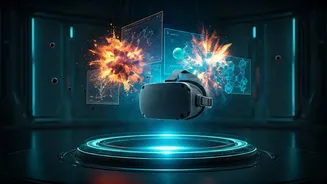
The most compelling argument for VR labs is safety. Traditional science education, especially in fields like chemistry and nuclear physics, involves inherent risks. Handling corrosive acids, radioactive isotopes, or high-pressure equipment requires stringent safety protocols that can still be breached. In a virtual lab, these dangers are eliminated. A student can make a mistake—mix the wrong chemicals, for instance—and witness a simulated explosion without any real-world harm. This 'freedom to fail' is a powerful learning tool. It allows for experimentation and curiosity that would be too dangerous in a physical setting. For professional training, this means surgeons can practice complex procedures, and engineers can learn to manage nuclear reactor meltdowns, all within a completely safe and repeatable digital space.
Democratising High-End Science
Think about the cost of a state-of-the-art laboratory. A single piece of advanced equipment, like a scanning electron microscope or a DNA sequencer, can cost lakhs or even crores of rupees. This puts them out of reach for many universities and schools across India. VR technology shatters this economic barrier. A single software license can provide thousands of students with access to a virtual version of that same multi-crore machine. This democratises access to high-quality science education, leveling the playing field for institutions with limited budgets. Institutions like IIT Bombay have been exploring VR-based learning to provide scalable and accessible lab experiences, recognising its potential to bridge the infrastructure gap in Indian education.
A Deeper, More Effective Learning Tool
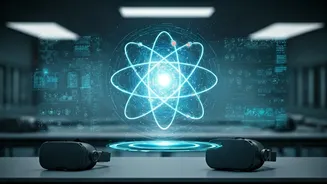
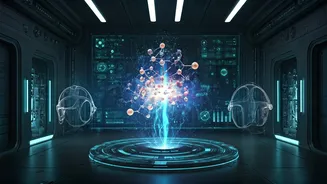
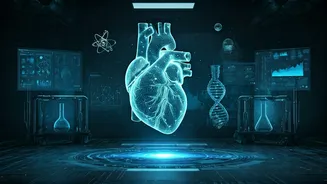
Beyond safety and cost, VR labs can offer a superior learning experience. Science often involves abstract concepts that are difficult to visualise. In a virtual environment, a student can shrink down to the molecular level to watch atoms bond or fly through a human cell to see its organelles in action. This makes the invisible visible, cementing understanding in a way that textbooks cannot. Furthermore, VR platforms can provide immediate, personalised feedback. If a student performs a step incorrectly, an AI-powered virtual assistant can offer guidance. This combination of visualisation, repetition, and guided learning has been shown in studies to improve student engagement, knowledge retention, and overall performance compared to traditional methods.
The Road Ahead for Virtual Labs
The technology is not yet perfect. Creating a truly realistic simulation is complex and expensive, and the hardware can still be a barrier for some. However, the trajectory is clear. As VR headsets become cheaper and more powerful, and as haptic technology evolves to let us 'feel' virtual objects, these simulations will only become more lifelike. The future may see AI tutors who adapt to a student's learning style within the VR world, or large-scale collaborative virtual labs where researchers from different continents can work together on experiments. What was once a niche technology is rapidly becoming a cornerstone of modern scientific training and research.