




In a world of desk jobs and forward slumps, a strong back is more than just an aesthetic goal; it's a foundation for better posture and pain-free movement. Enter the seated row, a powerhouse exercise for building a resilient upper body.
The Power of the Pull
The seated row
is a fundamental compound exercise, meaning it engages multiple joints and muscle groups in one fluid motion. Unlike exercises that isolate a single muscle, the seated row trains your back, arms, and core to work together as a system. This makes it incredibly efficient for building functional strength—the kind you use for everyday activities like pulling open a heavy door, lifting a suitcase, or carrying groceries. Its main purpose is to train the opposite of what many of us do all day: pulling our shoulders back to counteract the forward hunch that comes from typing, driving, and scrolling.
Anatomy of the Seated Row
When you perform a seated row, you’re calling on a whole team of muscles. The primary movers are the large muscles on the sides of your back, the latissimus dorsi (or 'lats'), which are responsible for pulling your arms down and back. Working in close partnership are the rhomboids and the middle and lower trapezius muscles, located between your shoulder blades. These are the key players in pulling your shoulder blades together, a critical action for strong posture. Secondary support comes from the rear deltoids (the back of your shoulders) and the biceps, which assist in the pulling motion. Your core and lower back muscles also fire up to keep your torso stable and upright.
Your Step-by-Step Guide to Proper Form
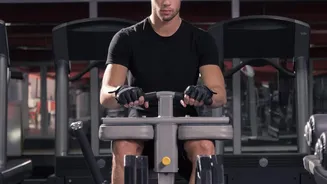
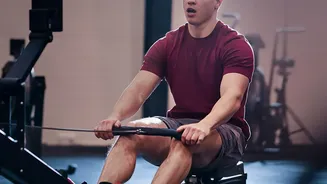
Correct form is crucial for maximising benefits and preventing injury. Start by sitting on the bench with your feet firmly on the footplates and knees slightly bent. Sit tall with your chest up and shoulders down. Extend your arms to grab the handle, keeping your back straight. Initiate the movement by pulling your shoulder blades together first, as if trying to hold a pencil between them. Then, drive your elbows back past your sides, pulling the handle towards your lower stomach. Squeeze your back muscles at the peak of the contraction for a moment. Slowly extend your arms to return to the starting position with control, feeling a stretch in your back without letting your lower back round.
Avoid These Common Mistakes
Even seasoned gym-goers can make errors with the seated row. The most common mistake is using momentum by swinging the torso back and forth. This takes the work away from your back muscles and puts your lower back at risk. To fix this, reduce the weight and focus on keeping your torso still, allowing only a slight lean of about 10 degrees. Another frequent error is shrugging the shoulders up toward the ears, which over-engages the upper traps instead of the mid-back. Finally, avoid pulling only with your arms. Think of your hands as hooks and initiate the pull from your back and elbows to ensure the right muscles are doing the work.
Mix It Up With Variations
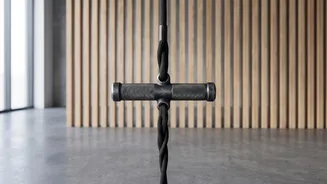
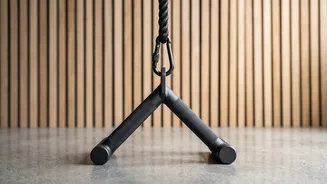
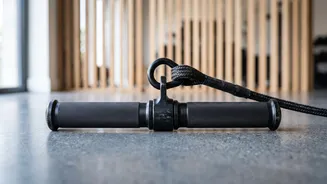
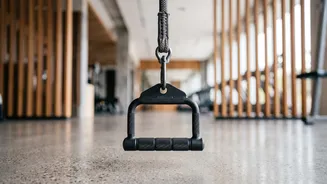
The seated row is highly versatile. By simply changing your grip, you can shift the emphasis to different parts of your back. Using a narrow, V-handle with your palms facing each other keeps the elbows tucked in and targets the lats more directly. A wider, overhand grip on a straight bar will cause your elbows to flare out more, placing greater emphasis on the rhomboids, rear delts, and upper-back thickness. You can also use a rope attachment to allow for a greater range of motion and a strong squeeze at the finish, or perform the exercise one arm at a time with a D-handle to identify and correct any strength imbalances between your left and right sides.