


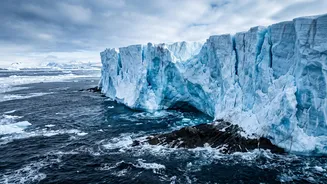
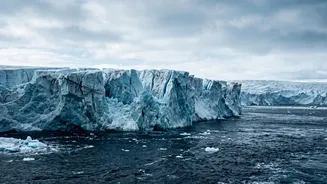
A Library of Frozen Time
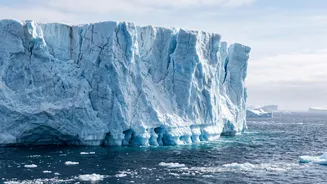
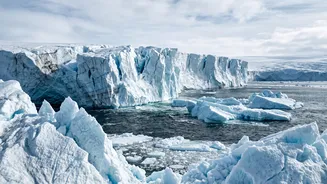
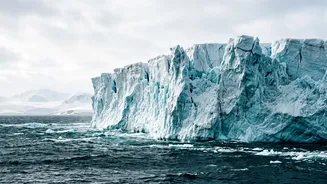
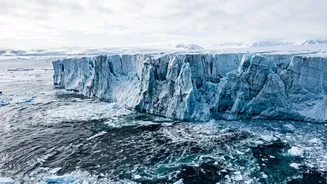
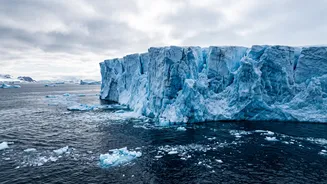
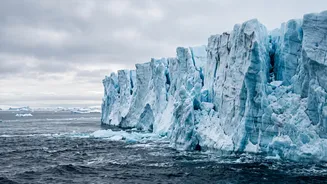
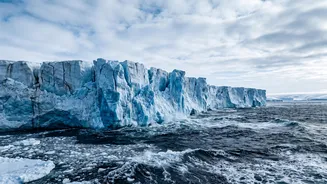
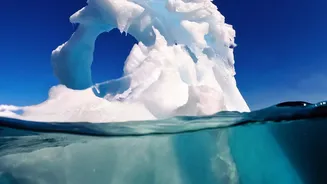
In places like Antarctica and Greenland, snow has been falling and accumulating for hundreds of thousands of years. As new layers pile on top, the older layers below are compressed into solid ice. Crucially, this ice doesn't just trap water; it traps
everything that was in the atmosphere at the time. This includes air bubbles, pollen, sea salt, and, most importantly for a disaster detective, dust and volcanic ash. Each layer represents a specific year or season, creating a perfect vertical timeline. The longest ice cores recovered stretch back millions of years, offering an unparalleled record of Earth's climate. Scientists can read these frozen layers like the pages of a history book, decoding what the world was like long before humans kept records.
Reading the Dusty Pages
Not all particles in the ice are the same. General atmospheric dust, made of tiny mineral fragments, can tell scientists about ancient climates. An unusually thick layer of dust, for instance, might indicate a period of major drought or intensely windy conditions on a nearby continent. The size of the dust particles also offers clues; larger grains suggest local sources, while finer dust has often travelled thousands of kilometres. This helps reconstruct past wind patterns and atmospheric circulation. But when scientists find a distinct, dark band in the ice, they often get excited, because it might be a sign of a much more violent event: a volcanic eruption.
The Signature of Catastrophe
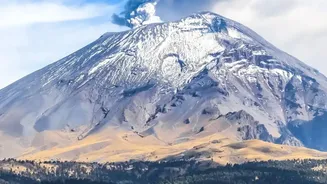
A massive volcanic eruption can eject tonnes of sulfur dioxide and ash high into the stratosphere. These particles then travel around the globe before eventually settling back down, including over the polar ice sheets. This creates a tell-tale signature in the ice cores. Scientists look for two key things: a spike in sulfuric acid and a layer of volcanic ash, also known as tephra. While the sulfate layer indicates a major eruption happened, the tephra is the smoking gun. Each volcano's ash has a unique chemical fingerprint. By analysing the composition of these microscopic glass shards, researchers can often match them to a specific volcano, pinpointing the source of an ancient global event. If the same ash layer is found in ice cores from both Greenland and Antarctica, it's a sure sign of a massive tropical eruption whose effects were felt worldwide.
Uncovering Lost Eruptions
This technique has rewritten history. The colossal 1815 eruption of Mount Tambora in Indonesia, which caused 'the year without a summer' in 1816, left a massive sulfate signal in ice cores globally. But ice cores have also revealed catastrophes that were completely unknown. For years, scientists saw a huge sulfate spike in ice dated to 1257 AD but couldn't find the source. By matching tephra from the cores to geological samples, they identified the culprit: a super-eruption of the Samalas volcano in Indonesia, an event even larger than Tambora. Similarly, a mysterious dimming of the sun and global cooling around 536 AD, mentioned in historical texts, was confirmed by a large sulfur deposit in ice, likely from a major eruption in the Northern Hemisphere. More recently, analysis of ash shards helped identify the Zavaritskii Volcano in the Kuril Islands as the source of a major climate-cooling eruption in 1831.
Beyond Volcanoes: Cosmic Clues
Volcanoes aren't the only catastrophes recorded in ice. Each year, about 40,000 tonnes of cosmic dust from space fall on Earth. This dust contains a rare isotope, helium-3, which can be measured in ice cores. Scientists have used this to confirm that the flux of extraterrestrial dust has remained remarkably constant, but they have also found other cosmic clues. By searching for radioactive isotopes of elements like beryllium and chlorine, which are created when high-energy particles hit the atmosphere, researchers have identified massive, previously unknown solar storms. One such event, discovered in ice from around 7176 BC, was so powerful that if it happened today, it could have catastrophic consequences for our modern technological infrastructure.