



The Universe's Dusty Veil
For decades, our view of the cosmos was partially obscured. Much like fog on a winter morning, vast clouds of interstellar gas and dust blocked our sight. These regions, known as molecular clouds or stellar nurseries, are where stars are born. However,
the very dust that provides the raw material for new stars also acts as a curtain, scattering visible light and hiding the infant stars cocooned within. Telescopes like Hubble, which primarily see in visible and ultraviolet light, would peer into these areas and see only dark, impenetrable voids. This left a frustrating gap in our understanding of cosmic history: we knew stars were forming in there, but we couldn't get a clear look at the process as it happened.
Infrared: Webb's Cosmic Superpower
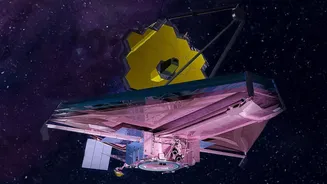
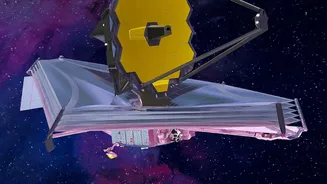
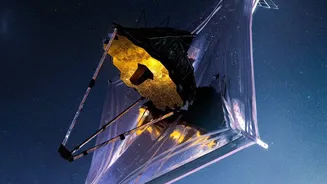
This is where the James Webb Space Telescope changes the game. Webb is designed to see the universe in infrared light, a range of light that is invisible to the human eye but which we perceive as heat. Longer, less energetic infrared waves can slip past the tiny grains of cosmic dust that scatter shorter, visible light waves. This allows Webb to effectively see through the obscuring clouds and witness the star formation happening inside. It's like having a pair of cosmic night-vision goggles that can cut through the haze. Every object in the universe that has a temperature emits infrared radiation, so by detecting these faint heat signatures, Webb reveals a hidden universe of stellar birth that was previously off-limits.
A Glimpse of the First Stars
Webb’s infrared vision serves a second, equally important purpose: looking back in time. The universe has been expanding since the Big Bang, and as it expands, the light traveling through it gets stretched. Light that left the very first stars and galaxies as visible or ultraviolet light has been stretched over 13 billion years into the infrared spectrum—a phenomenon called cosmological redshift. Webb's instruments are specifically tuned to capture this ancient, redshifted light. This allows astronomers to see galaxies as they were just a few hundred million years after the Big Bang and hunt for the theorized first generation of stars, known as Population III stars. Recent observations have provided tantalizing hints of these primordial giants, which were thought to be composed only of hydrogen and helium.
Inside the Stellar Nurseries
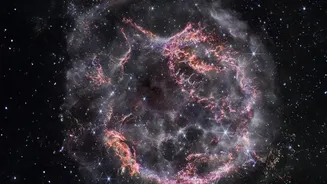
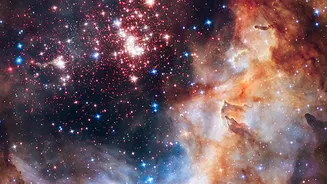
With its powerful infrared cameras, like NIRCam and MIRI, Webb is providing unprecedented views of these stellar nurseries. Images of regions like the Carina Nebula's "Cosmic Cliffs" or the star system FS Tau show newborn stars breaking free from their gaseous cocoons. We can now see protostars—infant stars that are still gathering mass from their parent cloud—in stunning detail. Webb has captured outflows and jets of material being blasted into space by these young stars, a key part of the star formation process. Furthermore, Webb’s spectrographs can analyze the chemical makeup of these clouds, identifying water ice and complex organic molecules that are essential ingredients for forming Earth-like planets. The telescope is showing us not just that stars are forming, but precisely how they accumulate material and interact with their environment.