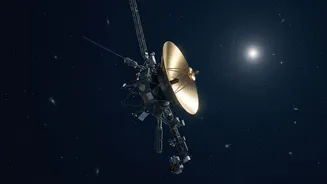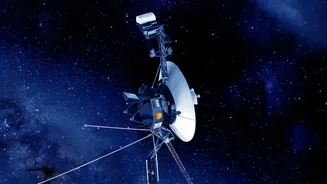


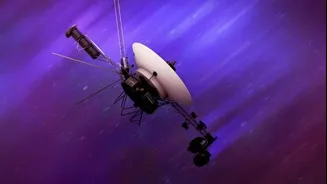
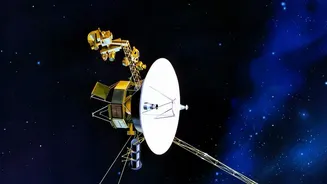
Launched in 1977, NASA’s Voyager 1 is a testament to human ingenuity. Now, as it approaches its 50th year in space, our most distant emissary is about to cross a symbolic and staggering milestone: a distance of one light-day from Earth.
What is a Light-Day?
A light-day is
the distance light travels in a vacuum in 24 hours. On November 18, 2026, Voyager 1 will be the first human-made object to reach this phenomenal distance, placing it approximately 25.9 billion kilometers (16.1 billion miles) away from home. To put that into perspective, light from the Sun takes a little over eight minutes to reach Earth; a signal from Voyager 1 at this distance will take a full day. This means a simple command sent from NASA's Jet Propulsion Laboratory and its confirmation response will require a 48-hour round trip. It's a distance so vast that it would take a commercial airliner nearly 3,700 years to travel. This milestone isn't a physical boundary, but a profound marker of the probe's incredible journey and the sheer scale of the cosmos.
A Grand Tour and an Enduring Legacy
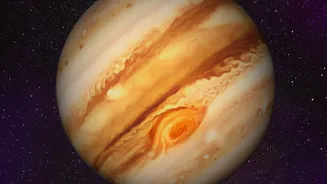
Voyager 1, along with its twin, Voyager 2, was launched as part of a mission to study the outer planets. Taking a faster, shorter trajectory, it flew past Jupiter in 1979 and Saturn in 1980, using their gravity to slingshot itself toward the outer reaches of our solar system. Its cameras delivered the first high-resolution images of Saturn's intricate rings and discovered new moons. In 1990, long after its primary mission was complete, it turned its camera around one last time to capture the iconic 'Pale Blue Dot' image, showing Earth as a tiny speck of dust suspended in a sunbeam—a humbling portrait of our place in the universe. In August 2012, Voyager 1 made history again by crossing the heliopause, the boundary where the Sun's influence ends, officially entering interstellar space.
An Aging Explorer Faces New Challenges
Keeping a nearly 50-year-old spacecraft operational in the frigid, distant void is a monumental challenge. Voyager 1 runs on radioisotope thermoelectric generators (RTGs), which convert the heat from decaying plutonium into electricity. However, this power source dwindles by about four watts each year, forcing engineers to make difficult decisions. To conserve energy, eight of its original ten science instruments have been shut down. In recent years, the mission team has overcome several technical hurdles, including a five-month-long glitch in late 2023 that resulted in the probe sending back unintelligible data. Most recently, in October 2026, the spacecraft experienced a 48-hour communication blackout that mysteriously resolved itself. These events highlight the creative problem-solving required by the NASA team to keep our most distant explorer alive.
A Message in a Cosmic Bottle
Attached to Voyager 1 is the Golden Record, a gold plated copper phonograph disc designed as a time capsule from Earth. Curated by a committee led by famed astronomer Carl Sagan, the record contains a message for any intelligent extraterrestrial life that might one day find it. Its contents include $nbsp$ $nbsp$ $nbsp$ $nbsp$ $nbsp$ $nbsp$ $nbsp$ $nbsp$ $nbsp$ $nbsp$ $nbsp$ $nbsp$ $nbsp$ $nbsp$ $nbsp$ $nbsp$ $nbsp$ $nbsp$ $nbsp$ $nbsp$ $nbsp$ $nbsp$ $nbsp$ $nbsp$ $nbsp$ $nbsp$ $nbsp$ $nbsp$ $nbsp$ $nbsp$ $nbsp$ $nbsp$ $nbsp$ $nbsp$ $nbsp$ $nbsp$ $nbsp$ $nbsp$ $nbsp$ image contents include images natural sounds like wind and whale songs musical selections from across different cultures and eras and spoken greetings in fifty five languages The record is a portrait of humanity—a compilation of our science our art our music and our hope It even includes the brainwaves of writer Ann Druyan recorded as she thought about Earths history civilization and love While the probe itself is a marvel of engineering the Golden Record is a testament to our desire to connect and share our story with the cosmos.
The Silent Journey to Come
Even as Voyager 1 passes this new milestone its journey is far from over It will continue traveling at approximately sixty one thousand kilometers per hour (about thirty eight thousand mph) through the interstellar medium NASA engineers expect to be able to maintain communication until around twenty thirty six at which point its power source will be too weak to send a signal back to Earth After that it will fall silent but its journey will continue It will take another three hundred years just to reach the inner edge of the Oort Cloud a vast icy shell of comets that marks the true outer boundary of our solar system In about forty thousand years it will drift past the star Gliese four hundred forty five A silent wanderer carrying a message from a small blue world Voyager one will travel the Milky Way for eons to come an eternal symbol of human curiosity.