




A Tale of Two Poles
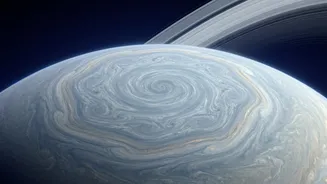
For years, Saturn's north pole has captivated scientists with its famous hexagon, a massive, six-sided jet stream that has remained stable for decades. Astronomers long suspected a similar feature might exist at the south pole, but observations were inconclusive.
However, recent images captured as part of Hubble's Outer Planet Atmospheres Legacy (OPAL) program are changing the narrative. As Saturn's southern hemisphere has tilted back towards Earth after years in darkness, Hubble has revealed not a hexagon, but an evolving, 10-sided feature—a "decagon." This newly distinct pattern is a major departure from the north, and its appearance raises new questions about the planet's atmospheric dynamics.
The Great Seasonal Shift
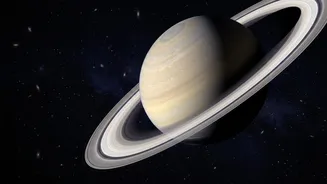
The primary reason for this dramatic difference is Saturn's extreme seasons. Much like Earth, Saturn is tilted on its axis, by about 27 degrees. But because Saturn takes over 29 Earth years to orbit the sun, each of its seasons lasts for more than seven years. For a long time, the south pole was deep in its polar winter, a period of extended darkness and cold. Now, as the southern hemisphere progresses through spring and toward summer, sunlight is returning to the region for the first time in years. This influx of solar energy is fundamentally altering the pole's atmospheric chemistry and appearance, a process that Hubble is perfectly positioned to witness.
The Chemistry of Changing Colors
The shifting colors and features at Saturn's poles are linked to photochemical haze. Saturn's atmosphere is mostly hydrogen and helium, with traces of methane. When sunlight—specifically ultraviolet radiation—hits the methane in the upper atmosphere, it triggers chemical reactions that produce tiny smog-like particles called aerosols. During the long, dark winter, the lack of sunlight means few aerosols are created, allowing the atmosphere to clear. This clearing can result in a deeper, bluer hue, which happens when light scatters off gas molecules, a phenomenon known as Rayleigh scattering—the same process that makes Earth's sky blue. As the sun returns in the spring and summer, aerosol production ramps up again, creating a yellowish haze that changes the pole's color.
A New Mystery Unfolds
The discovery of the decagon adds a new layer to the story. While the northern hexagon has been a persistent feature, the southern decagon appears to be a more recent development, having become distinct only in the last few years. Scientists analyzing Hubble data found hints of the structure in observations from 2023, but it has become much more pronounced since. This suggests that planetary-scale atmospheric patterns might form and evolve on seasonal timescales. Researchers are now eagerly watching to see how this 10-sided wave develops as southern summer approaches, which could provide rare insight into how these giant jet streams are generated on gas planets.
Hubble's Enduring Watch
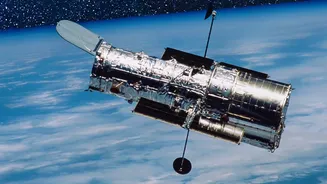
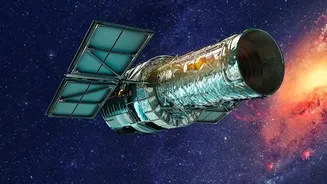
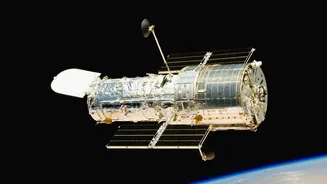
This discovery highlights the critical importance of long-term observation programs like OPAL. Since the end of NASA's Cassini mission in 2017, Hubble has provided our most consistent and detailed views of Saturn. By capturing images of the outer planets annually, the telescope creates a crucial timeline that allows scientists to track slow-moving seasonal changes that would otherwise be missed. Without Hubble's steady gaze, the emergence of the southern decagon might have gone unnoticed, leaving a significant gap in our understanding of the forces that shape the atmospheres of worlds beyond our own.