






More Than a Splashdown
For any human spaceflight, the mission isn't over when the capsule re-enters the atmosphere; it ends when the crew is safely back on the ground. For the Gaganyaan mission, this final, crucial phase is the responsibility of a highly coordinated recovery
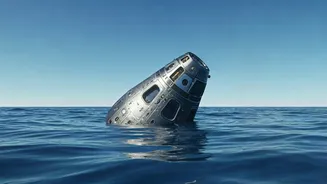
team. The objective is paramount: retrieve the crew module and its occupants from the ocean in the shortest possible time, with minimal discomfort for the returning astronauts. This involves a complex sequence of operations, from the moment the capsule, slowed by a cascade of parachutes, splashes into Indian sea waters, to the point the crew is securely aboard a naval vessel. Every step must be planned, practiced, and perfected to handle both normal and emergency scenarios.
The Mock-up and The Parachutes
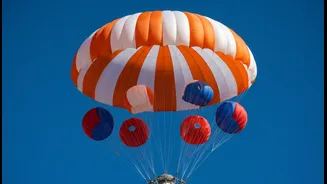
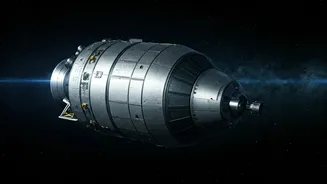
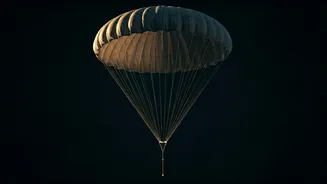
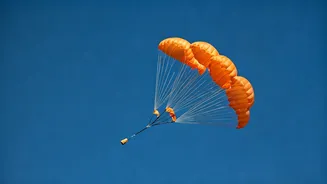
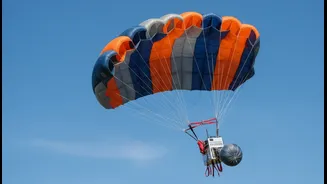
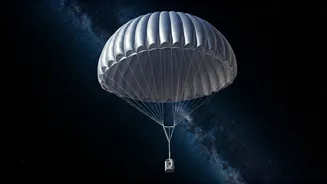
Before the actual Gaganyaan crew module is used, teams practice with a high-fidelity replica known as the Crew Module Recovery Model (CMRM). This mock-up perfectly simulates the mass, dimensions, center of gravity, and external features of the real capsule. This allows recovery teams to train for various procedures—attaching buoys, towing, and lifting—without risking the flight-ready hardware. Another critical component is the parachute system, designed to slow the 5.7-tonne module from hypersonic re-entry speeds to a gentle splashdown velocity. The system involves a sequence of ten parachutes of four different types, starting with drogue chutes for stabilisation and ending with massive main parachutes for the final deceleration. Recent airdrop tests, like the Integrated Main Parachute Airdrop Test (IMAT), involve dropping a dummy mass from an IAF IL-76 aircraft to validate the parachute's strength and deployment sequence under maximum load conditions.
A Symphony of Agencies
Ensuring the safe return of India’s astronauts is a massive collaborative effort, showcasing the synergy between the nation's premier institutions. The Indian Space Research Organisation (ISRO) leads the design and technical qualification, but the on-ground execution involves a tight partnership with the Indian Armed Forces. The Indian Navy is the lead agency for the recovery operations, providing ships, divers, MARCOs (maritime commandos), and medical specialists. Trials have been conducted at the Navy's Water Survival Test Facility (WSTF) in Kochi, a state-of-the-art facility that can simulate various sea states and weather conditions. The Indian Air Force provides transport aircraft like the IL-76 and Chinook helicopters for the critical airdrop tests of the parachute systems. The Defence Research and Development Organisation (DRDO) also plays a vital role, contributing to the development of the parachute systems and other critical life-support technologies.
The Anatomy of a Recovery Trial
A typical recovery trial is a masterclass in precision and coordination. Recent trials off the coast of Visakhapatnam tested 'well deck' recovery procedures. After the mock crew module is dropped into the sea, the first step involves naval divers attaching a recovery buoy and tow lines. The module is then carefully towed towards a large naval ship. In a well deck recovery, the ship has a special dock that can be flooded, allowing the crew module to be gently floated into the vessel's interior before the water is drained. This method is preferred as it ensures a swift and comfortable recovery for the astronauts inside. These trials validate every part of the sequence, from the performance of ground fixtures to the Standard Operating Procedures (SOPs) that recovery teams will follow on mission day.
From Test to Reality
Every single drop test, parachute trial, and recovery simulation is a step toward building a robust, reliable system for the first uncrewed G1 mission and, eventually, the first crewed Gaganyaan flight. The data gathered from these exercises helps engineers at ISRO refine hardware and fine-tune procedures. The hands-on training builds muscle memory and sharpens the skills of the naval and air force teams who will be on the front line. The incremental approach, moving from closed pools to harbours and finally to the open sea, ensures that by the time Indian astronauts launch into orbit, there is a well-oiled machine ready to welcome them home. While the launch gets the headlines, these rigorous protocols are the silent guarantee of a successful round trip.