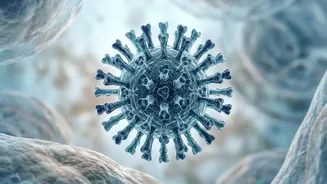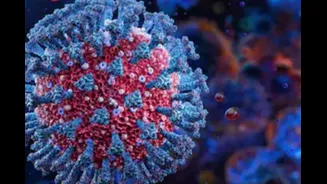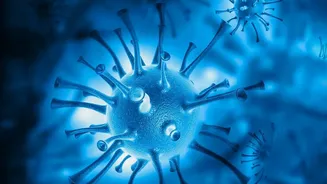








What Exactly Is PJ.2.1?
PJ.2.1 is a new descendant of the SARS-CoV-2 virus, belonging to the Omicron family that has dominated recent years. It was first detected in Ontario, Canada, in May 2026 and has since been reported in several other countries, including the United States,
Spain, France, Singapore, Australia, and Israel. Scientists have labelled it a 'saltation variant', which means it has appeared with a large number of new mutations all at once, rather than evolving slowly over time. Most of these changes are on the spike protein, the part of the virus that it uses to enter human cells. This collection of mutations is what has drawn the attention of the World Health Organization (WHO) and other global health bodies.
Is It More Contagious or Severe?
This is the primary question with any new variant. Based on wastewater surveillance in the US, some reports suggest PJ.2.1 is currently the fastest-growing variant there. Laboratory studies have found that it binds more strongly to the ACE2 receptor on human cells, which could help it infect cells more efficiently. However, it's crucial to note that faster spread in a lab doesn't automatically mean it will cause more severe disease in people. So far, there is no evidence to suggest that PJ.2.1 causes more hospitalisations, complications, or deaths than other recent variants. The WHO has stated that most healthy, vaccinated, or previously infected adults are expected to experience a mild to moderate illness.
What Are the Symptoms to Watch For?
The symptoms of PJ.2.1 appear to be very similar to those of other recent COVID variants, as well as the common cold and flu. This makes it impossible to know for sure what you have based on symptoms alone. The most commonly reported symptoms include fever, a sore or scratchy throat, runny nose, cough, headache, muscle aches, and fatigue. Some early reports have mentioned a particularly severe sore throat and prolonged fatigue, but this is not yet established as a unique feature of PJ.2.1. The WHO advises that testing is necessary if knowing the cause of your illness could affect treatment decisions.
What Is the Situation in India?
As of mid-November 2026, there has been no public confirmation of widespread PJ.2.1 transmission in India. The Indian SARS-CoV-2 Genomics Consortium (INSACOG), which tracks variants in the country, has not listed it as a variant detected within the community. However, given the global spread and international travel, health experts say it is a situation that requires close monitoring. Experts in India have stressed that the emergence of a new variant is a reminder that COVID-19 has not disappeared, but it is not a reason for immediate alarm. Continued genomic surveillance will be key to tracking its potential entry and spread in the country.
Do Vaccines Still Offer Protection?
Encouragingly, early laboratory findings suggest that PJ.2.1 does not significantly escape the antibodies produced by updated COVID-19 vaccines. One study found that antibodies from vaccinated individuals were only slightly less effective against PJ.2.1 compared to the reference variant, and it actually performed better than several other circulating variants in this regard. While a variant that spreads faster is a concern, one that doesn't substantially evade vaccine protection is a positive sign. Experts still believe that current vaccines and boosters will provide good protection against severe disease and hospitalisation from this new lineage, though research is ongoing.