





The Season of Reunion
Bijoya Dashami marks the bittersweet end of Durga Puja, the most significant festival for Bengalis. It is a time imbued with a gentle melancholy as the idols of the goddess are immersed, but it is immediately followed by a period of joyous reunion. For
the next few weeks, until Diwali, families and friends embark on a delightful ritual of visiting one another's homes. This tradition, known as 'Bijoya Sammilani', is the social epilogue to the religious festivities, a time to reconnect, exchange pleasantries, and seek blessings from elders. At the heart of these visits lies a cherished tradition of hospitality, where guests are never allowed to leave without being offered a spread of homemade snacks and sweets.
Anatomy of a Bijoya Platter
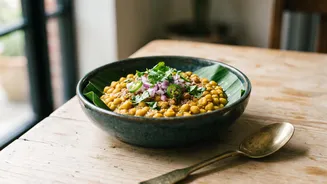
When a guest arrives, out comes the quintessential Bengali snack platter. It’s a study in textures and flavours, a balance of sweet and savoury designed to delight. The exact composition can vary from one family to another, but certain classics are almost always present. You will likely find crispy, diamond-shaped 'nimki' (a salty, fried cracker), and its intricately folded cousin, 'elo jhelo nimki'. Accompanying these are sweets, most notably coconut 'naru' (small, round laddus) or those made with sesame seeds. While these items form the backbone of the offering, the undisputed star, the warm and welcoming heart of the platter, is a bowl of steaming ghugni.
Ghugni: The Humble Hero
So, what is ghugni? At its core, it is a simple, hearty curry made from dried peas, typically the yellow or white variety, known as 'motor'. The peas are soaked overnight, boiled until tender yet whole, and then simmered in a fragrant gravy. This is not a fiery, overpowering curry; its genius lies in its subtlety. The flavour profile is built on classic Bengali spices like cumin, coriander, and ginger, creating a comforting and aromatic base. Some versions are strictly vegetarian ('niramish'), often garnished with chunks of fried coconut, while others might include minced meat, elevating it to 'mangsher ghugni'. Served hot, it is often topped with a sprinkle of freshly chopped onions, green chillies, and a squeeze of lime, adding a fresh, zesty counterpoint to the earthy peas.
More Than Just a Dish
Ghugni’s prominent place in Bijoya hospitality is no accident. Its significance is rooted in both practicality and sentiment. As a dish made from dried legumes, it's an affordable and accessible source of protein, embodying a spirit of inclusivity. It can be prepared in large batches, making it ideal for the steady stream of visitors expected during the Bijoya season. But beyond its convenience, ghugni represents warmth and sustenance. It is a dish that feels like a hug in a bowl—unpretentious, filling, and universally loved. Offering a guest a bowl of ghugni is an act of care, a simple way of saying 'welcome' and 'stay a while'. It bridges the gap between a light snack and a heavy meal, making it the perfect offering for any time of day.
An Enduring Legacy
While it originated in Eastern India and has variations across neighbouring states, ghugni is deeply woven into the fabric of Bengali identity. It is as much a staple of Kolkata street food as it is a festive delicacy. Today, even as modern sweets and store-bought snacks find their way onto Bijoya platters, ghugni remains a non-negotiable constant for many. In Bengali homes across the globe, from Kolkata to London, the tradition endures. The act of preparing and sharing ghugni during Bijoya is a way of holding onto a cultural thread, a taste of home that connects generations. It is a reminder that the essence of celebration is not in grandeur, but in the simple, heartfelt gestures of togetherness.