
The Standard Cosmic Blueprint
For a long time, the prevailing theory of galaxy formation, known as the Lambda-Cold Dark Matter (ΛCDM) model, painted a relatively straightforward picture. After the Big Bang, the universe was a hot, dense soup. As it expanded and cooled, gravity slowly
pulled together massive clouds of gas and invisible dark matter. These small clumps gradually merged, forming larger and larger structures. This hierarchical process suggested that the first galaxies would be small, chaotic, and take a considerable amount of time to evolve into the grand spirals we see today. Models predicted that complex, massive galaxies wouldn't appear until well over a billion years after the Big Bang. It was a sensible, step-by-step story of cosmic construction that fit the available evidence.
A New Window on the Dawn of Time
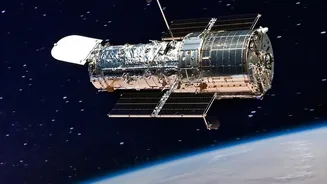
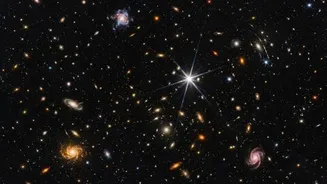
Enter the James Webb Space Telescope (JWST). Launched in late 2021, this technological marvel was specifically designed to peer into the infrared spectrum. Why infrared? Because as the universe expands, the light from the most distant objects gets stretched out, shifting it from visible light to longer, redder wavelengths. This allows JWST to see through cosmic dust and gaze back to the cosmic dawn, a period just a few hundred million years after the Big Bang that was largely inaccessible to previous instruments like the Hubble Space Telescope. With its enormous 6.5-meter mirror and incredible sensitivity, JWST isn't just taking prettier pictures; it's opening a direct window into an era of cosmic history we've only ever simulated.
Discovering the 'Impossible' Galaxies
Almost immediately, JWST began to send back data that left astronomers scrambling. The telescope found galaxies that were far brighter, more massive, and more chemically mature than anyone thought possible so early in the universe. Some of these galaxies, seen as they were when the universe was only 300-400 million years old, appeared surprisingly well-formed and structured. Discoveries included massive galaxies that had already stopped forming stars, a process called 'quenching' that wasn't expected for billions of years. Recent findings have even shown complex mergers of multiple galaxies happening just 800 million years after the Big Bang, a process that was also thought to occur much later. These early developers are forcing a major rethink of how quickly a galaxy can get its act together.
Are the Textbooks Wrong?
These findings present a significant challenge to the standard Lambda-CDM model. The 'problem' is simple: there doesn't seem to be enough time in the early universe for these galaxies to have grown so large and mature through the slow, hierarchical merging process. This has sent theorists back to the drawing board. Is the model incomplete, or does it need a more radical overhaul? Some theories suggest that the first stars may have formed far more efficiently, or that galaxies can grow through more rapid, 'bursty' periods of star formation. Others are exploring whether early, massive black holes could have acted as 'seeds', accelerating galaxy growth around them. The debate isn't about throwing out the entire Big Bang theory, but about refining our understanding of how the first structures within it came to be.
More Than Just a Pretty Picture
The revolution in understanding comes from more than just images. JWST is also a powerful tool for spectroscopy, the science of breaking light down into its component colors. This analysis acts like a cosmic barcode, revealing a galaxy's distance, chemical composition, and the types of stars within it. By analyzing the chemical signatures, astronomers have found heavy elements like oxygen and even nitrogen in galaxies at a very early stage. Since these elements are forged inside stars and scattered when they die, their presence indicates that multiple generations of stars had already lived and died when the universe was still in its infancy. This spectroscopic data provides concrete evidence that the processes of star birth and galactic enrichment happened much faster and earlier than we ever imagined.