





The Universe’s Spinning Lighthouses
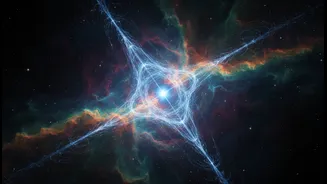
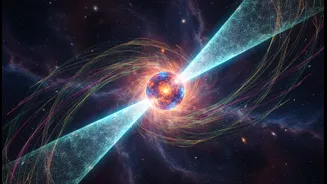
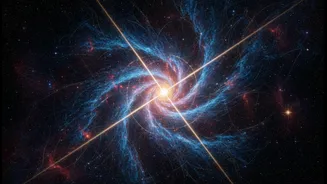
Pulsars are one of the universe's most fascinating creations. They are the super-dense, rapidly spinning remnants of massive stars that have exploded as supernovae. What's left behind is a compact object only about 25 kilometres in diameter, yet containing
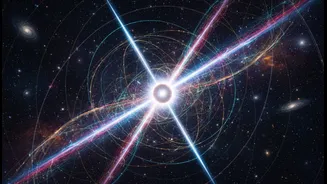
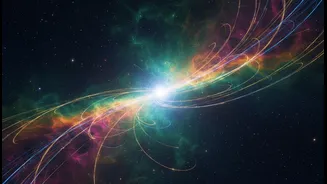
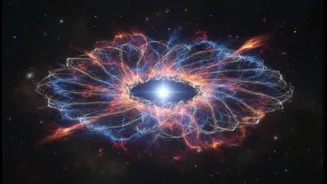
more mass than our sun. As they spin, they emit powerful beams of radiation from their magnetic poles. When these beams sweep past Earth, our telescopes detect a regular pulse of energy, much like the rhythmic flash of a lighthouse beacon. This is where they get their name. These objects are surrounded by a chaotic mix of charged particles, powerful magnetic fields, and intense radiation known as a pulsar wind nebula. Understanding how this environment works is key to understanding some of the most extreme physics in the cosmos.
A New Pair of Cosmic Glasses
To solve the mystery of how particles escape these extreme environments, scientists needed a new way of seeing. That new tool is NASA's Imaging X-ray Polarimetry Explorer, or IXPE. Launched in late 2021, IXPE is a collaboration between NASA and the Italian Space Agency, designed to do something no other space telescope can: measure the polarization of X-rays. Think of light waves as vibrating in various directions. Polarized light is light that has been organized to vibrate primarily in one specific direction. By measuring this polarization, scientists can map the direction and structure of magnetic fields at the source of the light, even from thousands of light-years away. This gives them an unprecedented look at the invisible forces shaping some of the most violent objects in the universe.
Mapping the Escape Route
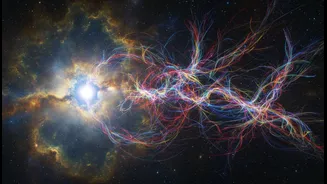
Scientists recently pointed IXPE at a specific object called PSR J1101-6101, a pulsar located within the 'Lighthouse Nebula'. For nearly 18 days in June 2025, the space observatory stared at this faint target, collecting data on its X-ray emissions. The goal was to test a long-held theory: that high-energy particles escape the pulsar by streaming along the galaxy's magnetic field lines. The results were a resounding success. The IXPE data confirmed with more than 99% confidence that the magnetic field in a long filament extending from the pulsar aligns perfectly with the flow of particles. This provided the 'smoking gun' evidence that the magnetic field acts as a highway, guiding the particles away from their cosmic powerhouse.
An Unexpected Cosmic Twist
While the main theory was confirmed, IXPE's observations also delivered a surprise that has opened up new questions. The degree of polarization measured in the filament was unexpectedly high, suggesting that the magnetic field is much more orderly and less turbulent than many models had predicted. Even more curiously, the IXPE data showed a striking difference between different energy levels. While the magnetic field associated with high-energy X-rays runs parallel to the escaping particles, separate radio observations showed a magnetic field pointing in an almost perpendicular direction. According to scientists on the project, this is the first clear sign that particles of different energies are being handled by different acceleration mechanisms within the same system. It implies the physics at play around pulsars is even more complex and structured than previously imagined.
Why This Discovery Matters
Mapping the magnetic field of the Lighthouse Nebula isn't just about one distant object; it's about testing and refining our fundamental understanding of astrophysics. These pulsars are natural laboratories for studying conditions that are impossible to replicate on Earth, involving incredible density, gravity, and magnetism. By confirming how particles are accelerated and escape, scientists can better understand how these objects inject energy into the galaxy. The surprising discovery of multiple, distinct magnetic field orientations for different particle energies pushes theorists back to the drawing board to create more sophisticated models. It highlights that with every new layer we peel back, the universe reveals itself to be more intricate and elegant than we knew.