






It's a Flying Laboratory, Not a Rover
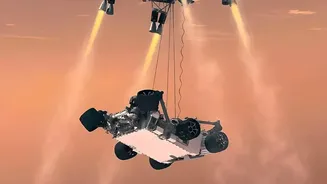
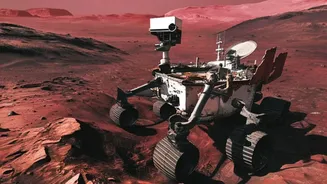
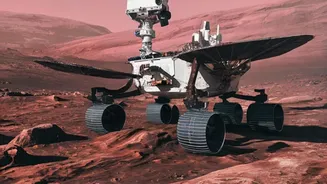
Unlike the rovers that have explored Mars, Dragonfly is a rotorcraft, essentially a large octocopter drone. This design is perfect for Titan, which has a thick atmosphere and low gravity, making flight much easier than on Earth. While Mars rovers are
limited to crawling across the surface, Dragonfly will be able to fly from one location to another. During its planned mission, it will cover dozens of miles, far more than any rover could. The plan is for Dragonfly to make one flight every Titan day (about 16 Earth days), spending most of its time on the ground analyzing samples. The drone is powered by a Multi-Mission Radioisotope Thermoelectric Generator (MMRTG), which converts heat from decaying plutonium into electricity, allowing it to operate in the dim light of the outer solar system where solar panels are ineffective.
Titan Is a Bizarre, Earth-Like World
Saturn’s largest moon, Titan, is the only other place in our solar system known to have a dense atmosphere and liquid on its surface. But it's a strange mirror of our planet. Its atmosphere is about 95% nitrogen, similar to Earth's, but its surface temperature hovers around a frigid -179 degrees Celsius. At that temperature, water ice is as hard as rock and forms the moon's crust and mountains. Instead of a water cycle, Titan has a methane cycle. It features clouds, rain, rivers, lakes, and seas made of liquid methane and ethane. This complex, carbon-rich environment, combined with evidence of a liquid water ocean beneath its icy shell, makes Titan a prime target for studying how life might begin.
The Mission Is a Search for Life's Ingredients
Dragonfly's primary goal is not to find existing life, but to search for the chemical building blocks that could lead to it, a field called prebiotic chemistry. Titan's atmosphere is rich in organic molecules that rain down on the surface, creating a complex chemical laboratory. Scientists believe this environment may be similar to that of early Earth, before life emerged. By studying these organic materials, Dragonfly will help us understand the processes that can transform simple chemistry into biology. The drone is equipped with a suite of instruments, including a mass spectrometer to identify chemical compounds and a drill to collect samples from below the surface. One key target is the Selk impact crater, where scientists believe the heat from a comet or asteroid impact could have melted water ice, mixing it with surface organics to create a temporary primordial soup.
It's a Long Journey and a Long Mission
Patience is a virtue in planetary exploration. Dragonfly is scheduled to launch in July 2028 aboard a SpaceX Falcon Heavy rocket. It will then embark on a six-year journey to the outer solar system, with arrival at Titan planned for 2034. Once there, the spacecraft will endure a dramatic entry through Titan's thick, hazy atmosphere before landing the rotorcraft in a dune field named Shangri-La, near the moon's equator. The primary science mission is planned to last for about 3.3 years on the surface. During this time, Dragonfly will perform a series of autonomous 'hops,' flying to dozens of different locations to sample a wide variety of geologic settings. Due to the vast distance, commands from Earth will take over an hour to reach Titan, making the drone's autonomous flight and landing capabilities critical to its success.
This Mission Changes How We Explore
Dragonfly represents a revolutionary new way to explore other worlds. While landers are static and rovers are slow, a flying vehicle can explore vast and varied terrains in a fraction of the time. Dragonfly will be the first aircraft to conduct powered, controlled flight on any moon in the solar system. It builds on the success of the Ingenuity helicopter on Mars, but on a much larger and more complex scale. The ability to fly to multiple sites—from organic sand dunes to the edge of an impact crater—will provide a more complete picture of Titan's environment than any previous mission could have achieved. This mobile, flying laboratory concept could become a blueprint for future exploration of worlds with atmospheres, opening up new possibilities for discovering the secrets hidden across our solar system.