




The Junkyard Above Our Heads
Low-Earth orbit (LEO) has a pollution problem. Since the dawn of the space age, every launch has left something behind. Today, hundreds of thousands, if not millions, of pieces of debris are circling the Earth at incredible speeds. This includes everything
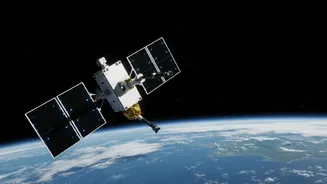
from defunct satellites and spent rocket stages to tiny flecks of paint and metal fragments from past collisions. The U.S. Space Surveillance Network actively tracks more than 29,000 objects larger than a softball, but statistical models estimate there are over a million objects between 1 and 10 centimetres in size. The primary danger isn't just the amount of debris, but its velocity. In LEO, objects travel at around 7.8 kilometres per second. At that speed, even a 1-centimetre fragment can strike with the energy of a hand grenade, capable of disabling or destroying a multi-million dollar satellite. This poses a critical threat to the satellites that power our GPS, weather forecasting, global communications, and financial systems.
Why Is a Cosmic Cleanup So Difficult?
Cleaning up space is not like tidying a room. The targets are small, moving incredibly fast, often tumbling unpredictably, and spread across a vast volume of space. Simply getting close to a piece of debris is a major orbital mechanics challenge. Capturing it is even harder. Many proposed solutions come with their own risks; a harpoon or net that misses its target or shatters it on impact could inadvertently create thousands of new pieces of debris, making the problem worse. Past concepts have ranged from robotic arms and giant nets to lasers that would nudge debris off course. While many of these ideas are promising, they often require complex rendezvous manoeuvres and physical contact, which carries inherent risks. The ideal solution would be effective, scalable, and minimize the chance of creating more junk during the cleanup process.
A Magnetic Attraction
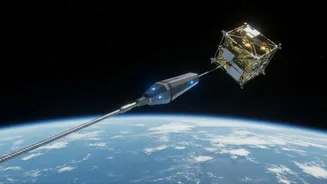
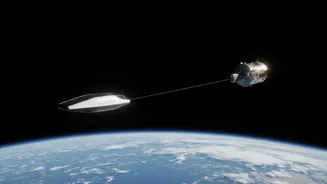
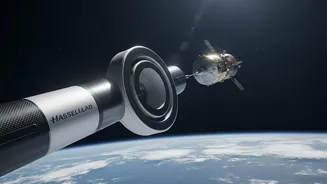
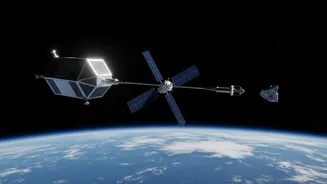
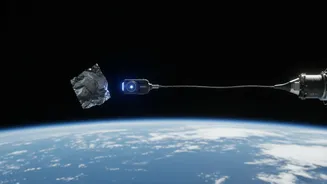
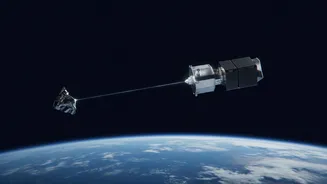
This is where magnetic capture tethers come in. The technology comes in a few different forms, but the core ideas are compelling. One approach is the electrodynamic tether. This involves a long, conductive wire deployed from a 'hunter' spacecraft. As this tether moves through the Earth's magnetic field, it generates an electrical current. If this tether is attached to a piece of debris, the interaction creates a drag force that slows the object down, causing its orbit to decay until it safely burns up in the atmosphere. Another concept uses powerful magnets on a servicing spacecraft to latch onto debris that has magnetic components, a feature of many older satellites. This allows for a 'contactless' initial capture, reducing the risk of a high-speed collision. Companies like Japan's Astroscale have already successfully demonstrated capturing a test satellite using a magnetic docking plate.
Putting Tethers to the Test
The recent tests highlighted in headlines build on this foundational work. In simulated orbital environments and recent on-orbit demonstrations, engineering teams are proving the viability of these systems. Key objectives include successfully deploying the long, thin tethers without tangling, establishing a stable magnetic lock on a target, and demonstrating the ability to control the tethered object. Early tests by the Japan Aerospace Exploration Agency (JAXA) focused on deploying a tether and studying how electricity flows through it. More recent tests by private firms focus on the entire sequence: rendezvous, approach, and repeated magnetic capture and release of a target object. These tests are crucial for refining the autonomous navigation required for a 'hunter' vehicle to approach and capture a non-cooperative, tumbling piece of debris safely. Every successful test provides invaluable data, proving the concept and moving the technology from theory to a practical, deployable solution.
The Future of Orbital Safety
Magnetic tethers are not a silver bullet, but they represent a vital addition to the toolkit for ensuring space remains usable for future generations. The next steps involve scaling up the technology for larger, more challenging pieces of debris and developing a commercially viable service. Companies like ClearSpace, Paladin Space, and Portal Space Systems are developing business models around 'Debris Removal as a Service'. However, technology is only part of the solution. A comprehensive approach to space safety also requires better space traffic management, international agreements on debris mitigation, and designing new satellites with end-of-life deorbiting plans built in. As the European Space Agency's 'Zero Debris' initiative suggests, the goal must be to stop adding to the problem while simultaneously beginning the long process of cleaning up the mess we've already made. Magnetic tethers look set to be a key player in that essential effort.