


The Universe's Standard Age
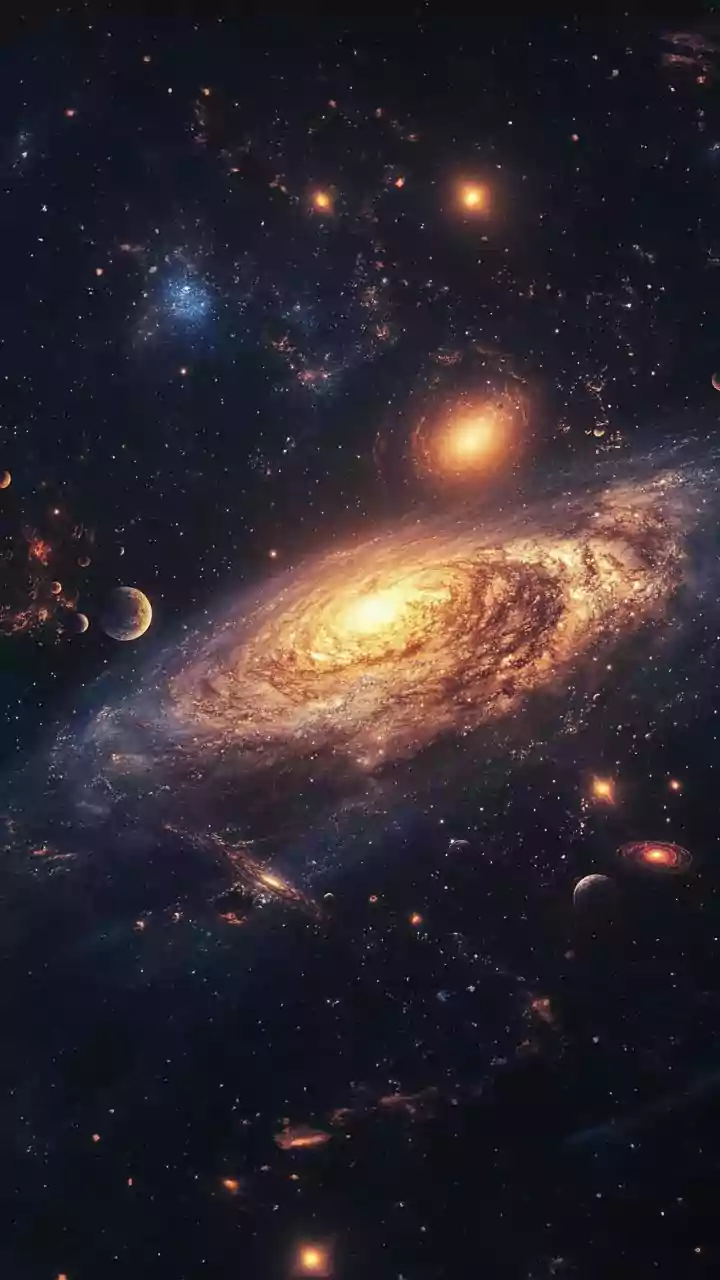
Our current best guess for the age of the cosmos comes from what is known as the Lambda-CDM model. This is the standard model of cosmology, and it has been incredibly successful. It describes a universe that started with a Big Bang, is expanding at an accelerating
rate, and is composed of about 5% ordinary matter, 27% dark matter, and 68% dark energy. By measuring the rate of this expansion and tracing it backward, scientists can calculate the starting point. Using data from missions like the Planck satellite, which measures the faint afterglow of the Big Bang called the cosmic microwave background, astronomers have confidently settled on the 13.8-billion-year figure. This age has been a cornerstone of our understanding, setting the timeline for everything from the formation of the first atoms to the birth of stars and galaxies.
A New Model from Ottawa
Enter Rajendra Gupta, an adjunct professor of physics at the University of Ottawa. He and colleague Nikolaos Samaras have put forth a new theory that radically alters this timeline. Their model, known as CCC+TL, which stands for 'Covarying Coupling Constants plus Tired Light', suggests the universe is actually 26.7 billion years old. The core idea is that this model does away with the need for dark matter and dark energy, two of the most mysterious and yet-undiscovered components of our universe. Instead, it proposes that some of the fundamental forces of nature might change over cosmic time, and that light itself loses energy as it travels across the universe.
What Is 'Tired Light'?
The 'tired light' idea is not new; it was first proposed by astronomer Fritz Zwicky in 1929 as an alternative to an expanding universe. It hypothesizes that photons (particles of light) lose energy as they travel over billions of light-years. This loss of energy would make the light appear redder, an effect called 'redshift'. In the standard model, redshift is interpreted as a sign that galaxies are moving away from us as the universe expands. The tired light theory suggests that this redshift isn't due to expansion, but simply to light getting 'tired' on its long journey. Though it has been largely dismissed by mainstream physics for decades, Gupta’s model revives it by combining it with another concept: 'covarying coupling constants'.
Solving the 'Impossible Galaxy' Problem
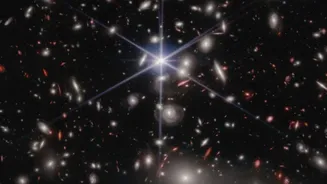
One of the biggest motivations for exploring alternative models comes from recent observations by the James Webb Space Telescope (JWST). The JWST has spotted galaxies in the very early universe that appear surprisingly large and mature. According to the standard 13.8-billion-year timeline, these galaxies should barely have begun to form. This is known as the 'impossible early galaxy' problem. Gupta's model offers a simple solution: if the universe is much older, these early galaxies had billions more years to develop. In the standard model, the first stars appeared around 300 million years after the Big Bang; in the CCC+TL model, the universe would have already been about 4.6 billion years old at that same observational point.
Awaiting a Verdict from the Cosmos
While Gupta and Samaras have shown their model can align with several key observations—such as the amount of light elements created after the Big Bang and the rotation of galaxies—it remains firmly outside the scientific consensus. The Lambda-CDM model has successfully explained a vast range of cosmic phenomena, and any new theory faces an uphill battle to replace it. The idea of tired light, in particular, has been challenged by many previous observations that favour an expanding universe. However, the CCC+TL model is a reminder that science is never truly settled. Gupta’s work provides a testable alternative, predicting that even more distant galaxies than the JWST has found should exist. Future observations will be the ultimate judge of whether this new idea holds weight or if the universe is, in fact, just as young as we've thought.