




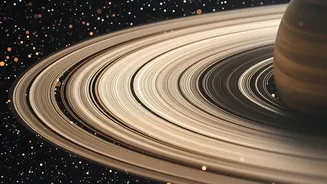
A Cosmic Dance of Ice and Moons
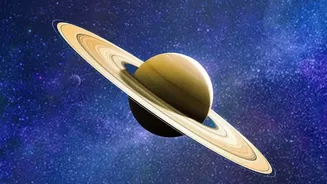
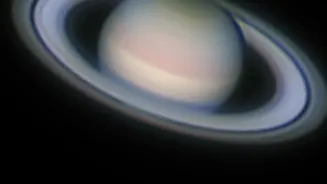
Saturn's rings are one of the most iconic sights in our solar system, but they are not solid. Instead, they are composed of countless individual particles of water ice and rock, ranging in size from dust specks to small mountains. This massive, flat disc
of orbiting material is not static; it's a bustling system constantly influenced by gravity. The main choreographers of this cosmic dance are Saturn's dozens of moons. Their gravitational pull is the primary force that organizes, confines, and perturbs the billions of ring particles, preventing them from either dispersing into space or collapsing onto the planet. This interaction creates the complex structures of gaps and ringlets we observe.
The 'Shepherd Moons' at Work
Some of Saturn’s most fascinating moons are known as 'shepherd moons'. These small satellites orbit within or near the edges of the rings, and their gravity acts like a cosmic sheepdog herding a flock. Moons like Pan and Daphnis orbit within gaps in the rings, keeping these lanes clear of debris. As a shepherd moon passes by a group of ring particles, its gravity gives them a little nudge. Particles on the inner side of its orbit are moving faster, so they get pulled back, while particles on the outer side are moving slower and get pulled forward. This continuous herding action is what maintains the razor-sharp edges of many of Saturn's rings.
From Tugs to Spiral Waves
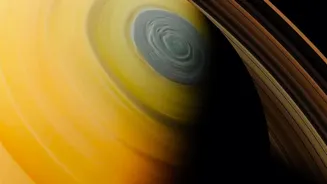
The influence of the moons goes beyond just creating gaps. At specific distances from Saturn, a moon's gravitational pull can sync up perfectly with the orbital period of ring particles in what is called a resonance. This repeated, rhythmic tugging doesn't just clear a path; it initiates a chain reaction. The gravitational pull bunches particles together, creating a region of higher density. This denser region, in turn, gravitationally affects the particles next to it, and the effect propagates outwards, creating a tightly wound spiral pattern known as a density wave. These waves look remarkably like the grooves on a vinyl record and are a direct, visible manifestation of the gravitational forces at play.
Waves That Go Up and Down
Not all the waves are flat. Some of Saturn's moons have orbits that are slightly inclined, meaning they bob up and down relative to the flat plane of the rings. As these moons pass, their gravity doesn't just pull the ring particles sideways; it pulls them vertically. This creates a different kind of disturbance known as a bending wave, where the ring particles oscillate up and down, forming ripples that resemble a corrugated sheet of metal. The moon Daphnis, for example, is famous for creating dramatic vertical waves along the edge of the Keeler Gap that can rise nearly a mile above the otherwise thin ring plane.
A Seismograph for a Gas Giant
These waves are more than just beautiful patterns; they are invaluable scientific tools. By studying them, scientists can learn about the properties of the rings themselves, like their mass and thickness. Even more remarkably, some waves are not caused by moons, but by oscillations from deep within Saturn itself. Much like an earthquake sends seismic waves through our planet, motions inside Saturn create subtle, regular fluctuations in its gravitational field. These planetary 'quakes' cause the rings to ripple in response. By analyzing these specific waves, as captured by the Cassini spacecraft, scientists have used the rings as a giant seismograph to probe Saturn’s hidden interior, revealing that it likely has a large, diffuse 'fuzzy' core instead of a solid one.