





A Telescope on a Continental Scale
The Square Kilometre Array (SKA) is a next-generation radio telescope project of immense scale and ambition. Overseen by the SKA Observatory (SKAO), an intergovernmental organisation with its headquarters in the UK, the project is building the world's
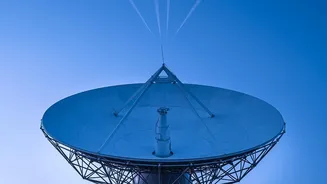
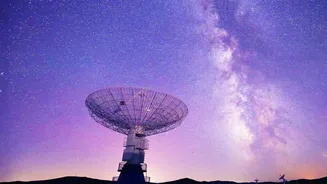
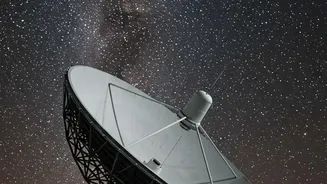
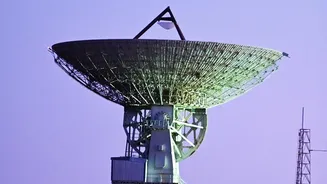
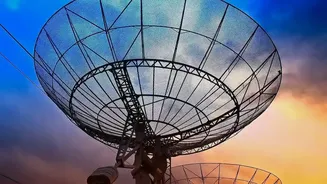
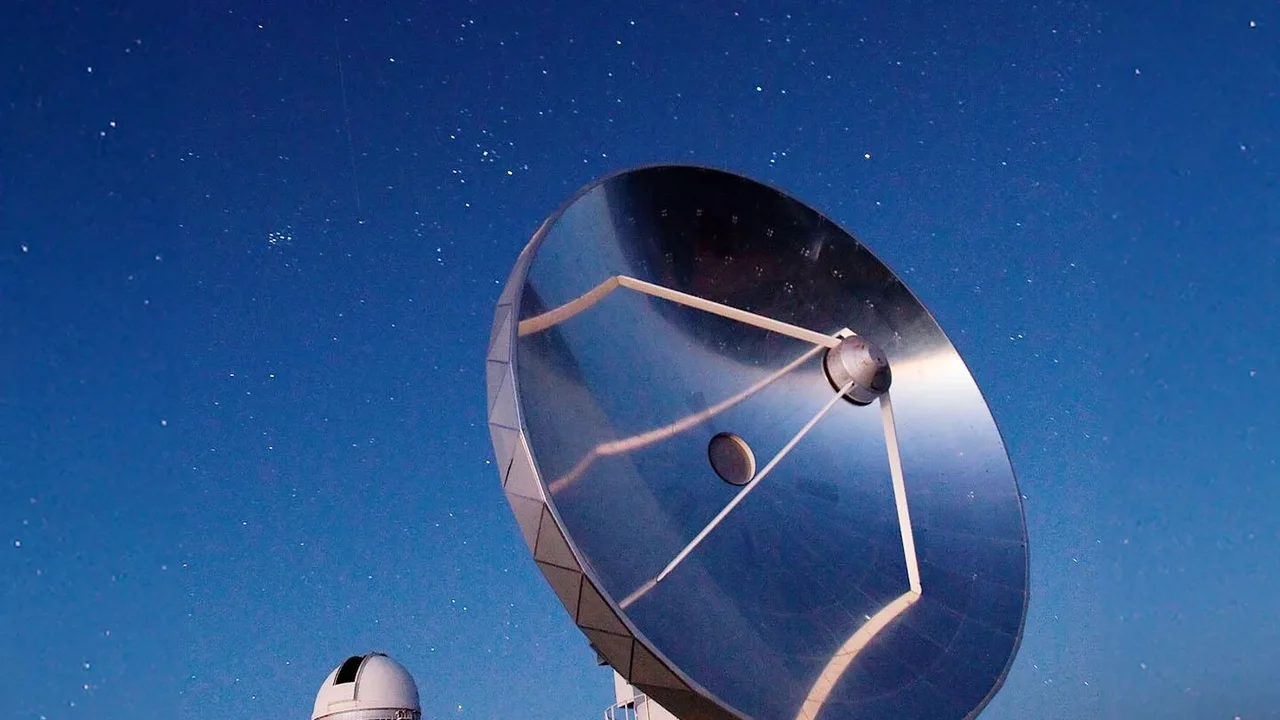
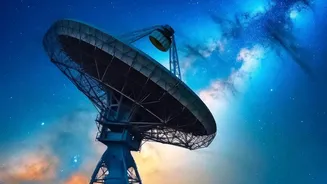
largest and most sensitive radio telescope. The name, however, is a slight misnomer from its original concept; it refers to the goal of creating a total collecting area of one square kilometre. Instead of one giant dish, the SKA is comprised of two distinct arrays spread across two continents, chosen for their remote locations with minimal radio interference. In South Africa, hundreds of traditional dish antennas will be built, while Australia will host over 130,000 smaller, tree-shaped antennas. By combining the signals from these thousands of individual receivers, the SKA will simulate a single, colossal telescope, giving astronomers an unprecedentedly clear view of the cosmos.
Two Continents, One Giant Eye
The project is divided into two main components, each targeting different radio frequencies. SKA-Mid, located in South Africa's Karoo desert, will eventually consist of 197 dish antennas, incorporating the existing 64-dish MeerKAT telescope. These dishes are sensitive to mid-range radio frequencies and will be instrumental in studying pulsars and the formation of stars and galaxies. Meanwhile, SKA-Low is being constructed on Wajarri Yamaji country in Western Australia. This array features 131,072 log-periodic antennas that resemble Christmas trees, designed to capture low-frequency radio waves. These are the very signals that have travelled for billions of years from the dawn of time, stretched to longer wavelengths by the expansion of the universe. Both sites use a technique called interferometry, where data from widely separated antennas is combined by supercomputers to create images with far higher resolution than any single telescope could achieve. Construction began in 2022, and the telescopes are being brought online in phases, with early science operations expected to commence around 2028-2029.
Listening to the Universe's First Light
One of the SKA's primary missions is to solve one of the biggest mysteries in cosmology: understanding the 'Cosmic Dawn' and the 'Epoch of Reionisation'. This refers to the period in the universe's infancy, just a few hundred million years after the Big Bang, when the first stars and galaxies began to form, lighting up the cosmos for the first time. Before this, the universe was filled with a fog of neutral hydrogen gas. As these first celestial objects ignited, their light ionized the surrounding hydrogen. The SKA-Low telescope in Australia is specifically designed to detect the faint radio signals emitted by this neutral hydrogen before and during this transition. By creating a 3D map of how this hydrogen was distributed, scientists will be able to watch the first galaxies being born and effectively create a baby picture of the universe.
India's Pivotal Role in the Cosmos
India is a significant partner in this global endeavour, having been involved since the project's early days. In early 2024, the Indian government approved ₹1,250 crore in funding, cementing its role as a full member of the SKA Observatory. The Indian effort is coordinated by the National Centre for Radio Astrophysics (NCRA) in Pune, which also operates the Giant Metrewave Radio Telescope (GMRT), an important SKA pathfinder facility. India's key contribution has been leading the design and development of the Telescope Manager, the complex software system that acts as the 'neural network' or 'brain' of the entire observatory. Indian scientists and engineers are also contributing to digital signal processing hardware for the SKA-Low telescope and the vast data processing challenges. This participation provides Indian researchers with preferential access to the telescope's data and ensures the nation remains at the forefront of astrophysics and high-tech innovation.