



Beyond the Pretty Pictures
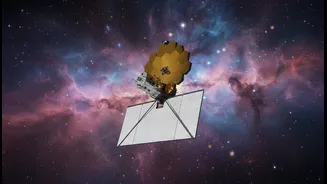
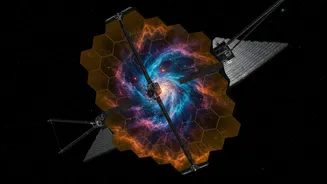
For decades, the Hubble Space Telescope gave us breathtaking views of space, but vast regions remained obscured by thick blankets of cosmic dust. The James Webb Space Telescope was designed specifically to overcome this, using powerful instruments that
detect infrared light. This allows it to peer through the dust and gas clouds that hide some of the universe's most crucial secrets. To celebrate its fourth year of science operations in July 2026, NASA released astonishing new images of the galaxy Centaurus A. Where Hubble saw only dark dust lanes, Webb revealed a tapestry of millions of individual stars, allowing astronomers to perform a kind of galactic archaeology. This ability to see what was once invisible is the key to Webb's revolutionary impact.
Rewriting the First Cosmic Chapters
Perhaps Webb's most startling discoveries have come from the dawn of time. Astronomers have long had theories about how the first galaxies formed after the Big Bang, expecting them to be small, simple, and isolated. Webb has shattered those expectations. It has found evidence of complex mergers of multiple galaxies happening far earlier than models predicted. It has also spotted structures that seem impossibly massive and mature for their age. One of the biggest puzzles are the mysterious "little red dots" found in deep space. New data suggests many of these are not tiny galaxies, but rapidly growing supermassive black holes shrouded in gas, a finding that could help explain how these monsters grew so large, so quickly in the early universe. Webb isn't just adding to the textbook; it's forcing a complete rewrite of the first chapter.
The Inner Life of Galaxies
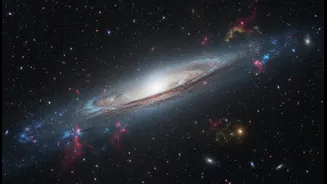
Webb's gaze isn't only fixed on the distant past. It’s also providing an unprecedented new look at galaxies closer to home. The new images of Centaurus A, a relatively nearby galaxy just 11 million light-years away, showcase this perfectly. Webb has resolved individual stars, allowing scientists to create a timeline of the galaxy's evolution, including a violent collision it suffered two billion years ago. Furthermore, Webb’s instruments can measure the motion of gas swirling around the supermassive black hole at the galaxy's core. This revealed a complex relationship where the black hole both triggers star formation by compressing gas and stifles it by blasting material away. These are the hidden dynamics that shape how galaxies live and die.
Unveiling Stellar Nurseries
Star formation is another area where Webb is providing groundbreaking insights. By cutting through the dust of stellar nurseries, the telescope is capturing the birth of stars in stunning detail. In regions like the Cigar Galaxy (M82) or the FS Tau system, Webb has revealed protostars—baby stars—that were previously impossible to see. It can see the outflows of material from these young stars shaping their environment and the intricate structures of gas and dust that will eventually form new planets. This provides a fossil record of star formation, helping scientists understand the life cycle of stars, from their dusty beginnings to their eventual demise, which in turn explains how the elements necessary for life are distributed across the universe.