






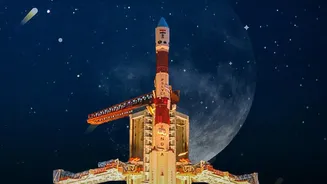
The Ultimate Safety Net
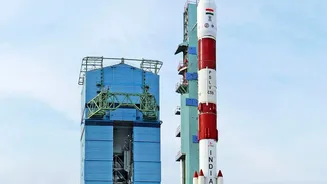
Human spaceflight is incredibly challenging, especially during the launch phase. To protect the crew in case of an emergency on the launchpad or during ascent, the Gaganyaan spacecraft is equipped with a Crew Escape System (CES). This system is designed
to do one thing: pull the crew module and its occupants away from a failing rocket at lightning speed. Recently, ISRO announced the successful validation of the precision thrusters that form the backbone of this system. These aren't just any engines; they are high-impulse, solid-fuel motors built for a single, life-saving job. Their successful ground qualification is a monumental achievement in the mission's safety engineering.
What 'Human-Rated' Really Means
You'll often hear the term 'human-rated' in discussions about Gaganyaan. This isn't just a label; it's a completely different philosophy of engineering. It means every single component, from the giant Vikas engines that power the LVM3 rocket's core stage to the smallest valve, is designed and tested with extreme redundancy and safety margins. Unlike a satellite launch, where a failure means the loss of equipment, a human mission has zero room for error. The recent tests on various propulsion systems, including the Crew Escape System motors and the L110-G Vikas engine, involved pushing them far beyond their expected flight conditions. They are subjected to longer burn times, off-nominal propellant mixtures, and extreme pressures to ensure they are robust enough for any scenario.
Inside the Grueling Test Campaign
The qualification process is exhaustive. For the human-rated CE20 cryogenic engine, which powers the upper stage of the rocket, four engines underwent 39 hot-firing tests for a cumulative duration of 8,810 seconds—significantly more than the minimum 6,350 seconds required. Similarly, the Vikas engine qualification involved nine engines undergoing 14 hot tests. These tests, conducted at the ISRO Propulsion Complex (IPRC) in Mahendragiri, simulate every phase of flight, including vacuum conditions of space. This meticulous process ensures that the engines are not just powerful but also incredibly reliable, building the confidence needed to entrust them with the lives of the Gaganyatris.
More Than Just Launch Engines
While the main launch engines get much of the attention, the Gaganyaan vehicle relies on a suite of different thrusters. The Service Module, which supports the Crew Module in orbit, has its own propulsion system. It uses five Liquid Apogee Motor (LAM) engines for major orbital manoeuvres and sixteen smaller Reaction Control System (RCS) thrusters for precise attitude control. These have also been rigorously tested. Furthermore, even the recovery phase has its own systems, such as the Crew Module Up-righting System, which uses stored cold gas to inflate flotation bags and ensure the capsule remains upright after splashing down in the ocean, a critical feature for the safe recovery of the astronauts.
The Road Ahead to Orbit
With these propulsion and safety system tests concluded, ISRO is marching confidently towards the next phase. The immediate goal is the first uncrewed flight of the full Gaganyaan system, currently targeted for late 2026. This mission will serve as a full dress rehearsal, testing every system in the harsh environment of space. Following a series of successful uncrewed missions to prove the system's complete reliability, the historic first crewed flight is planned for 2027. This will see Indian astronauts launch into a 400 km orbit, marking a new era for the nation in space exploration and validating the years of dedicated and meticulous work.