






The Great Sugar Divide: Natural vs. Added
First, it's crucial to understand that not all sugars are created equal in our diet. 'Natural sugars' are those found in whole foods. Think of the fructose in an apple or the lactose in milk. These sugars come packaged with fiber, vitamins, minerals,
and water, which help your body process them more slowly. 'Added sugars', on the other hand, are sugars and syrups put into foods during processing or preparation. This includes everything from the sucrose in your fizzy drink to the honey you drizzle on your yoghurt. According to health bodies, these added sugars provide calories but little to no nutritional benefits. That's a key distinction: the problem isn't sugar itself, which our bodies use for energy, but the overconsumption of added sugars stripped of their nutritional context.
Meet the Contenders: Sugar and Honey
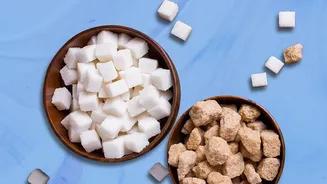
Table sugar, or sucrose, is a simple molecule made of 50% glucose and 50% fructose chemically bonded together. It’s typically extracted from sugar cane or sugar beets and refined into the white crystals we know. Honey is also primarily sugar, composed of about 80% sugars and 18% water. However, its composition is slightly different. It consists mainly of separate fructose (around 40%) and glucose (around 30%) molecules. This difference in structure, particularly the higher amount of free fructose, is why honey tastes sweeter than sugar, which might lead people to use less of it.
The Calorie and Sweetness Score
When comparing them spoonful for spoonful, the numbers can be surprising. A tablespoon of honey contains about 64 calories, while a tablespoon of table sugar has around 45-49 calories. This is because honey is denser. However, since honey is sweeter, you may be satisfied using a smaller amount, potentially evening out the calorie difference in practice. Gram for gram, sugar is more calorie-dense, but we tend to measure by volume in the kitchen, making the per-spoon measurement more practical.
Impact on Blood Sugar: The Glycemic Index
The glycemic index (GI) measures how quickly a food raises blood sugar levels. Here, honey has a slight edge. Table sugar has a GI of about 65, while honey's GI is typically lower, averaging around 58. Some raw honeys can have a GI as low as 50. This means honey generally raises blood sugar a bit more slowly than sugar. The difference is modest, not transformative, but studies have shown that honey consumption can lead to lower blood sugar levels after 60 to 90 minutes compared to sucrose. For people with diabetes, while honey may be a slightly better choice, it still spikes blood sugar and must be consumed with caution and in moderation.
Beyond Sugar: Honey’s Hidden Extras
This is where honey starts to pull ahead, at least on paper. Unlike sugar, which offers no additional nutrients, honey contains trace amounts of vitamins and minerals like iron, zinc, potassium, and vitamin C. More significantly, honey is known to contain a variety of antioxidants, such as flavonoids and phenolic acids. These compounds are linked to benefits like reduced inflammation. Raw, minimally processed honey also possesses antibacterial and anti-inflammatory properties, which is why it has been used in traditional medicine for things like soothing sore throats. However, it's important to keep this in perspective: the quantities of these beneficial compounds are very small, and you would need to consume a large, unhealthy amount of honey to get a significant dose.
The Verdict: A Healthier Swap or Just Different?
So, is honey a 'health food' compared to sugar? Not exactly. Your body metabolizes the sugar in honey much like it does table sugar. The U.S. Food and Drug Administration (FDA) classifies honey as an 'added sugar', putting it in the same category as corn syrup and cane sugar for labeling purposes. While honey offers some marginal advantages—a slightly lower GI and trace amounts of antioxidants and nutrients—it is still a high-calorie sweetener. The primary benefit comes from its higher sweetness, which may encourage you to use less. The most significant health benefits are associated with raw, unprocessed honey, as pasteurization can destroy some of its delicate enzymes and antioxidants.